Movie Spring Summer Fall Winter and Spring Again
Kim Ki-duk, Bound, Summer, Autumn, Winter … and Spring
A man for all seasons
The Bodhisattva of Compassion,
When he meditated securely,
Saw the emptiness of all five skandhas
And sundered the bonds that caused him suffering.
—The Heart Sutra
IN A Globe obsessed with finding significance and validation through being a somebody,Spring, Summer, Autumn, Wintertime … and Spring tells the story of a solitary monk who has plant meaning through forsaking the secular realm and diving deep into the very depths of his ain soul. And yet, despite his secluded beingness, the exterior earth inevitably comes calling, reminding us that detachment can only ever truly be a state of mind and disposition of heart.
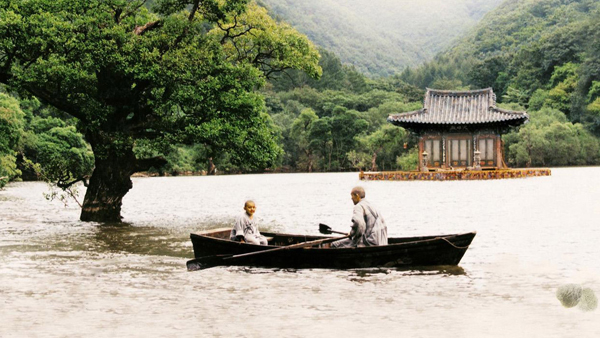
Written and directed past Korean auteur, Kim Ki-duk's exquisitely beautiful masterpiece filmed at Jusan Pond in North Gyeongsang Province in South korea portrays the subsequent relationship between a Buddhist renunciate and his young protégé, characters whose names are never relayed. Nevertheless, despite the picture show'southward absenteeism of whatsoever specific temporal referencing,Spring, Summer, Autumn, Winter … and Jump is a deeply sophisticated meditation on the vagaries of the human condition reflected inside the passing seasons of nature.
Spring, Summer, Autumn, Winter … and Bound.
Photo: © Sony Pictures Classics
Here then,
Form is no other than emptiness,
Emptiness no other than form.
Grade is only emptiness,
Emptiness only course.
—The Centre Sutra
Akin to Michelangelo Frammartino'due south Le Quattro Volte, which explores like themes associated with the transience of life set against a properties of the natural landscape, the stunning tall topography forms an integral element to this elegiac drama, with each of the five titular segments representing a stage in a homo's life and the associated lessons he must acquire.
Despite the minimal use of dialogue, through the utilize of Buddhist iconography and Aesopian symbols, we go acutely aware of the inherent message of the aboriginal nondual teachings embodied in the doctrine of the Three Universal Truths—annica (impermanence), dukka (suffering) and anatta (no self)—as they unfold throughout the movie, with the principles of the Four Noble Truths—the causes and cessation of suffering—forming the didactical framework through which the plot evolves.
Jump, Summer, Autumn, Winter … and Spring
Photo: © Sony Pictures Classics
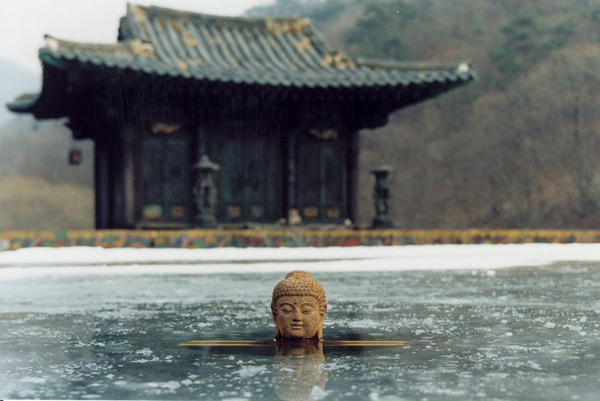
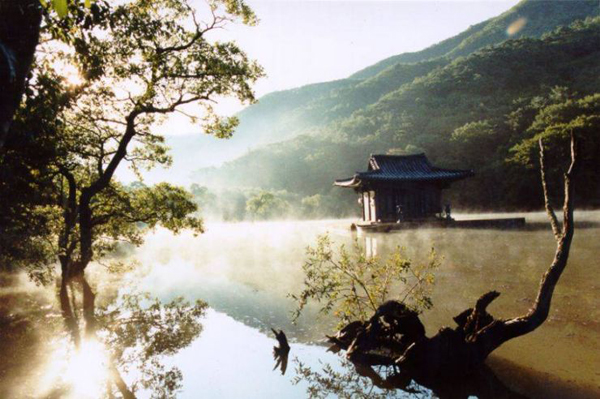
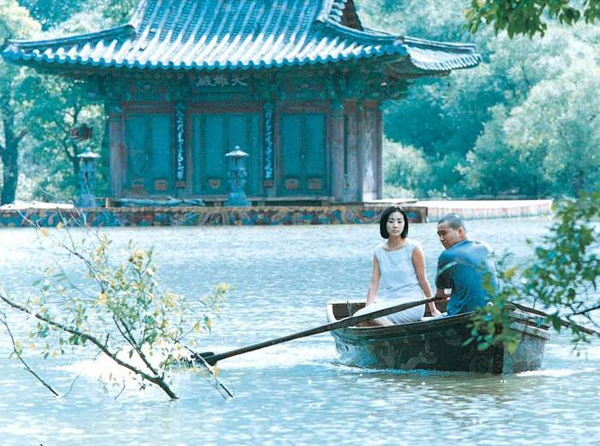
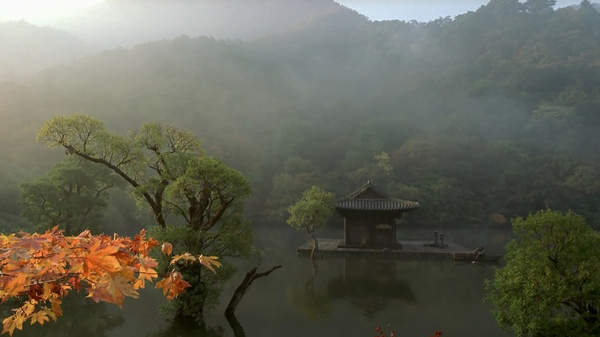
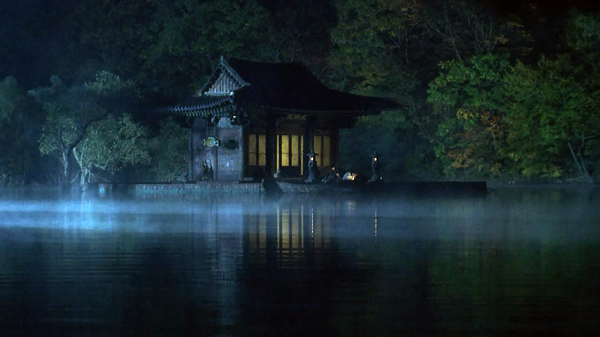
Moreover, in a film steeped in visual imagery, the lake itself functions every bit a metaphor for universal listen, its silent waters the very embodiment of the enlightenment country, with the floating hermitage representative perhaps of the fragile self, drifting silently atop its omnipresent depths.
Similarly, the monastery's humble rowboat is symbolic of the private'south journey on the spiritual path. Beautifully painted with images of Guan Yin (the bodhisattva of compassion and mercy) as she extends a paw that holds the lotus-built-in child, Maitreya, the futurity Buddha, it is the yana or vehicle by which the young monk is transported to his spiritual destiny, across the bounding main of samsara to the mountain shore of liberation and release.
Leap, Summer, Autumn, Winter … and Spring.
Photo: © Sony Pictures Classics
Feeling, idea and pick,
Consciousness itself,
Are the aforementioned equally this.
All things are by nature void
They are non built-in or destroyed
Nor are they stained or pure
Nor do they wax or wane.
—The Centre Sutra
And thus it is springtime. In the mode of a dramatized Eastern fable, the film commences with two wooden carved doors of a "gateless gate" creaking open up to reveal a mysterious monastery drifting upon the serene surface of a swimming, whose sole occupants are an former monk (Oh Immature-soo) and his kid disciple (Kim Jong-ho). Life is quiet and unproblematic and like any young male child, the master's student enjoys playing with his puppy and collecting herbs until one day, he is consumed by the capricious cruelties of childhood.
Spring, Summer, Fall, Winter … and Bound.
Photograph: © Sony Pictures Classics
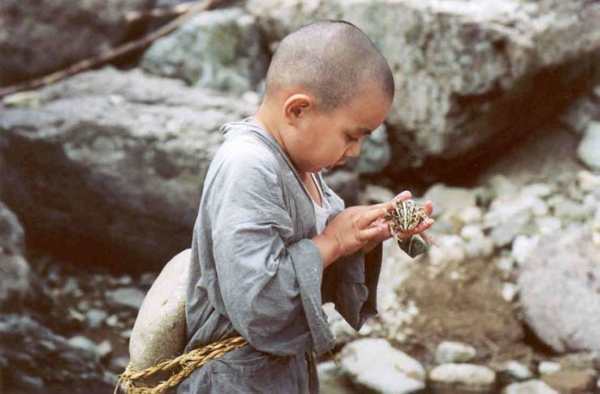
After tying pebbles to a fish, a frog and a snake, the young monk later awakens to find that he himself is fettered by a big smooth rock tied to his dorsum. It is the first harsh lesson to be learnt, non through angry chastisement merely by redemptive endeavour: the old monk calmly instructs the young male child to release the creatures from their suffering, vowing that if whatever of the animals dice, "Y'all volition comport the rock in your center for the rest of your life."
Indeed, the get-go Noble Truth—the nature of suffering—is a grave precept to take on board at such an early age, fabricated all the more poignant by the weeping of the boy when he discovers that although the frog has managed to survive, both the fish and ophidian take perished, signalling a portentous omen of that which is however to come up.
Spring, Summertime, Autumn, Winter … and Bound.
Photograph: © Sony Pictures Classics
So, in emptiness, no form,
No feeling, thought or pick,
Nor is at that place consciousness.
No centre, ear, nose, natural language, torso, mind;
No colour, audio, scent, gustatory modality, touch,
Or what the heed takes hold of,
Nor even act of sensing.
—The Eye Sutra
The wooden gates open once once more, this time on the season of summer. The young novice is now a teenager (Seo Jae-kyung), moderately skilful at keeping the Buddhist rituals of the temple in place. Soon, nonetheless, the tranquillity of the hermetic abode is disturbed by the arrival of a young woman, affected with an unspecified malady. The master allows her to stay in order to restore her concrete and mental forcefulness, noting calmly, "When she finds peace in her soul, her trunk will render to health."
Spring, Summer, Autumn, Wintertime … and Spring
Photograph: © Sony Pictures Classics
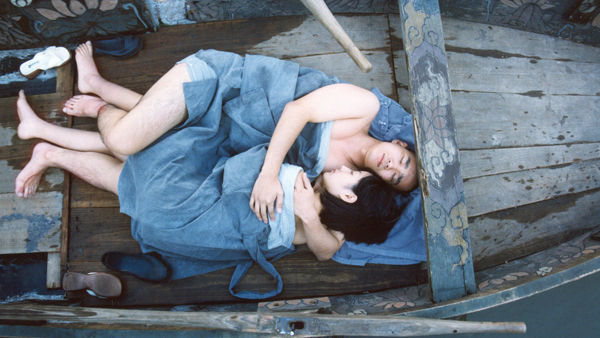
Needless to say, the young adult female awakens sexual desire in the student, with their playful flirtations culminating in passionate lovemaking amidst shoreside rocks and the hull of the master's rowboat. Upon discovering their underground tryst, the former monk is, nevertheless, unmoved and but observes, "Lust leads to desire for possession, and possession leads to murder," once again foreshadowing later events. He and so dispatches the young adult female, now healed, back to her mother. The pupil is devastated and, forsaking his monastery home, follows afterwards her leaving his eremitic life backside.
The lush and idealized surroundings where nature is in its fullest bloom has seeped deep into the soul of the student, stimulating the innate need for consummation and lust. Indeed, the master acknowledges the inevitability of his protégé's deportment by stating wrily information technology is only natural for him to succumb; without the full realization of the Buddha'due south teachings, the cause of our pain and anguish, every bit the 2d Noble Truth wisely informs us, is unfettered craving and desire.
Spring, Summer, Autumn, Winter … and Spring
Photograph: © Sony Pictures Classics
No ignorance or end of it,
Nor all that comes of ignorance;
No withering, no death,
No stop of them.
—The Heart Sutra
The wooden threshold at present reveals the arrival of autumn. The one-time monk has considerably aged and yet his modest life is as it always was. Returning from a trip to replenish food supplies, past chance, the master notices devastating news virtually his old student reported in the local newspaper. Anticipating his imminent arrival, the pupil returns, now a thirty-year-old fugitive (Kim Youg-min), on the run from a violent criminal offence he has recently committed.
Bound, Summer, Fall, Winter … and Bound
Photo: © Sony Pictures Classics
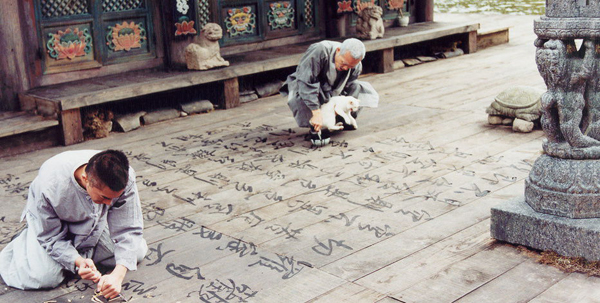
In an act of penance, the student attempts suicide but his master beats him brutally before writing out the Eye Sutra (Prajnaparamitahrdaya or The Centre of the Perfection of Wisdom) on the monastery deck, using his cat'south tail as a calligraphy brush. When he finishes, he commands the immature monk: "Carve out all of these characters and while you are etching, anger volition be cut out of your heart." As the disciple's rage dissipates through the painstaking transcription, two policemen arrive to abort the young monk and carry him away to his fate.
Once over again, the erstwhile monk is left alone to reflect upon the purpose of life. His duty towards his former student is now completed for he understands that even the pursuit of wisdom itself is rooted in emptiness. He builds a funeral pyre in the rowboat and, covering his ears, eyes, nose and oral cavity with paper in the manner of the traditional Buddhist expiry ritual, is engulfed by flames as the boat drifts slowly beyond the lake, the scene closing with a ophidian slithering along the hermitage deck.
Spring, Summer, Autumn, Winter … and Jump
Photograph: © Sony Pictures Classics
Nor is there pain, or crusade of hurting,
Or cease in pain, or noble path
To lead from hurting;
Not fifty-fifty wisdom to accomplish!
Attainment also is emptiness.
—The Center Sutra
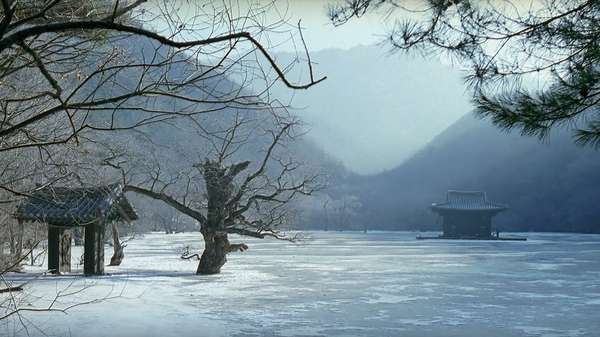
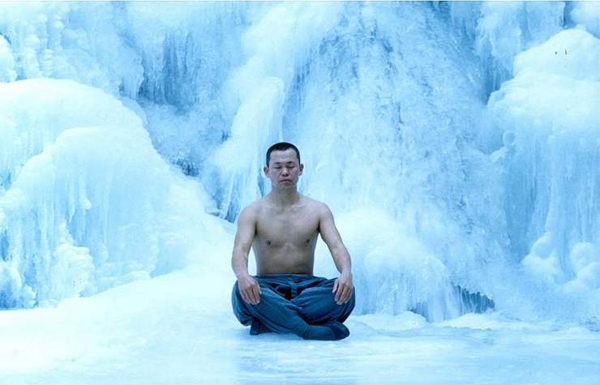
The creaking of the wooden doors now reveals wintertime has descended upon the secluded monastery, long since abased and frozen in ice. Once again, the student returns (as the manager himself, Kim Ki-duk), this fourth dimension on parole as a mature man in middle historic period. Coming to the realization that his beloved teacher has left the temporal earth, he excavates his master's charred remains from the icy corpse of the rowboat, placing them on the chantry, and so embarks upon a new life of prayer, meditation and qigong.
Spring, Summer, Fall, Wintertime … and Spring.
Photograph: © Sony Pictures Classics
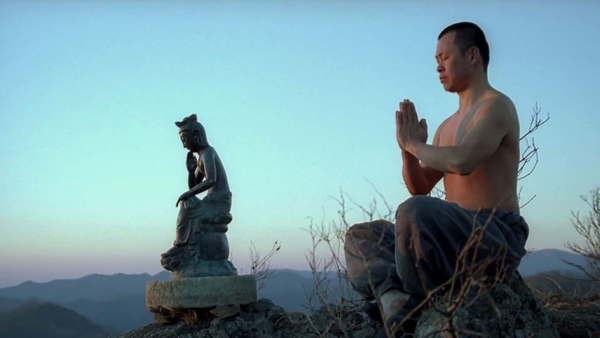
The monk'south spiritual journey is finally coming to an terminate every bit the last two of the Buddha's Noble Truths are now realized through penance and disciplined adherence to the steps of the Eightfold Path. And thus, in a pilgrimage of amende for the accumulation of all the suffering in his heart, both unwittingly and wittingly enacted, the monk takes out a statue of Guan Yin, so attaches a millstone to his trunk with a rope and drags information technology to the top of a mount, whereupon he sits in meditation, looking downwardly on his floating hermitage and reflecting upon the unending cycles of human being beingness.
Information technology is not before long that a veiled woman appears, bearing an infant, whom she entrusts in the intendance of the monk. Slipping away in the dead of night, the young mother slips on the frozen pond's surface and falls down a hole, simply to be discovered the following morning trapped lifeless under the water ice.
Leap, Summer, Autumn, Winter … and Leap.
Photo: © Sony Pictures Classics
So know that the Bodhisattva
Property to nothing whatever,
But home in Prajna wisdom,
Is freed of delusive hindrance,
Rid of the fearfulness bred past information technology,
And reaches clearest Nirvana.
—The Heart Sutra
The wooden threshold opens ane final time on a beautiful spring day. The infant is now a young boy and the former student is at present master to his new charge. The student is seen tormenting a turtle, harking dorsum to the capriciousness of his predecessor at the beginning of the tale and the egoic seed of attachment and destruction impregnated within in all beings, preparing us nonetheless again for the cycle of life to outset anew …
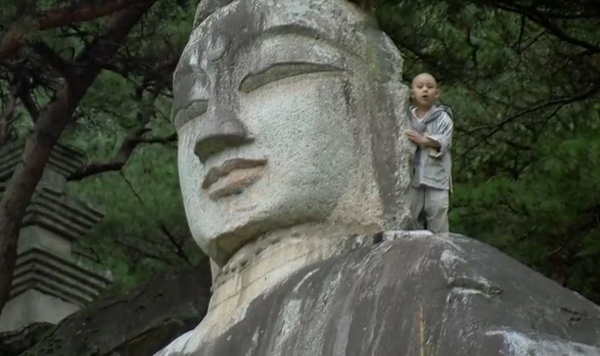
Jump, Summer, Fall, Winter … and Spring.
Photograph: © Sony Pictures Classics
Thus the circle of life repeats itself once again—nature rejuvenates herself every four seasons, man reincarnates himself through the lifespan of every man and yet everything remains exactly every bit it was, is, and shall forever be. As the movie fades into emptiness, for several moments afterwards nosotros feel the ambience sounds of the natural world—the tinkling of the air current chime, birdsong, the lapping of h2o confronting the rowboat—continuing to resonate deep inside the states, instilling reverence for the sacredness of nature and sublimity of the empty void.
Exquisitely scored and shot with each frame exuding the composition of a painting, Jump, Summer, Fall, Winter… and Spring transmits a transcendental beauty all of its own, elevating the soul with its elegant and timeless aesthetic from innocence, through honey and evil, to enlightenment and finally rebirth, subtlely and silently observed by the impassive gaze of a bodhisattva.
Bound, Summer, Fall, Winter … and Spring.
Photograph: © Sony Pictures Classics
All Buddhas of past and present,
Buddhas of future time,
Using this Prajna wisdom,
Come to full and perfect vision.Hear then the great dharani,
The radiant peerless mantra,
The Prajnaparamita
Whose words allay all hurting;
Hear and believe its truth!Gate Gate Paragate Parasamgate
Bodhi Svaha
Gate Gate Paragate Parasamgate
Bodhi Svaha
Gate Gate Paragate Parasamgate
Bodhi Svaha
—The Centre Sutra
Buy DVD
Post Notes
- Michelangelo Frammartino: Le Quattro Volte
- Pavel Lungin: The Island
- Alan Watts: Deject-Hidden, Whereabouts Unknown
- Apichatpong Weerasethakul: Uncle Boonmee Who Tin can Recall His Past Lives
- Philip Gröning: Into Great Silence
- Edward A. Burger: Amidst White Clouds
- Paula Marvelly: The Monasteries of Meteora
- Lao Tzu: Tao Te Ching
Join Our Newsletter

Source: https://www.theculturium.com/kim-ki-duk-spring-summer-autumn-winter-and-spring/
0 Response to "Movie Spring Summer Fall Winter and Spring Again"
Post a Comment