7 Concepts Associated With the Automotive Industry You Must Know
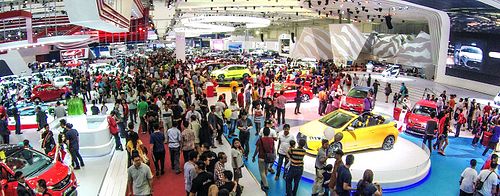
The automotive industry in Indonesia plays an important role to the economic growth of the nation, contributing x.16 percent of the GDP.[1] Indonesia automotive product exports is currently higher in value than their imports.[two] In 2017, Indonesia is the 17th largest bus producer in the globe and the 5th largest jitney producer in Asia, producing 0.98 1000000 vehicles.[three]
Near of the vehicles built in Indonesia are from foreign brands, notably Japanese, and produced in the land through a articulation venture plant with a local partner or a fully owned found. While full manufacturing with a high percentage of local components in the country is normally preferred by manufacturers and encouraged by the government, several plants in the country as well conducted a CKD assembly. CBU imports of new cars in the state is also immune since 1999 with considerably light import tariffs, although information technology is discouraged by the regime.
Republic of indonesia predominantly produces mini or compact MPVs (52 percent of full production), SUVs and light pickup trucks under one ton. In 2019, a full 26 percent of its product output was exported. Around 7.ii percentage of full automobile sales in Republic of indonesia consists of imported vehicles, notably from Thailand, Japan, Bharat, and to lesser extent, South korea.
Most automobile manufacturers in Indonesia (including rider car manufacturers and commercial truck manufacturers) are a member of the non-governmental Association of Indonesia Automotive Industries (Gabungan Industri Kendaraan Bermotor Indonesia, GAIKINDO).
Characteristics [edit]

The Toyota Avanza was the all-time-selling passenger car in Republic of indonesia betwixt 2006 and 2019 consecutively, and then in 2021.
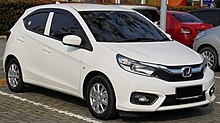
The Honda Brio became the acknowledged passenger car in Indonesia in 2020 before existence its position was retaken by the Avanza in 2021.
Traditionally, Indonesia is a market heavily oriented to Japanese cars like most of its Southeast Asian neighbours. However, while other Southeast Asian markets adopt compact sedans, Indonesian auto market has a strong preference to three-row MPVs.[iv] [5] [6] In 2019, 96.3 per centum of cars and trucks sold in Indonesia are from Japanese brands.[seven] The percentage is even college than the proportion of Japanese brands in Japan itself which stood at 90 percent.[8] In the same year, around 550,000 cars or 68 per centum of passenger cars sold in Indonesia consisted of MPVs, crossovers and SUVs equipped with three rows of seats.[7] The percentage is one of the highest in the world. For instance, in 2006, models such every bit Toyota Avanza (xvi.4%), Toyota Kijang Innova (14.half-dozen%), Daihatsu Xenia (7.4%), and Suzuki Carry/Futura (7.iii%) had a very high market share. Top ten best-selling models consisted of virtually 73 percent of domestic sales of the vehicles in 2006.[9]
Japanese manufacturer Toyota is leading the market share in Indonesia for decades since the early 80s. Despite that, the largest manufacturer in Republic of indonesia is Daihatsu as several popular Toyota-branded models sold in Indonesia are developed and produced by Daihatsu, which is wholly owned by Toyota since 2016. The subsidiary, Astra Daihatsu Motor (ADM) operates several plants capable of producing a total 530,000 cars per year.[x] Around ii out of 5 automobiles sold in Indonesia is produced past ADM.
Apart from Indonesian consumers wanting a big car to conduct the whole family, the popularity of MPVs or three-row cars in general could be explained by the regulations and the car culture that followed subsequently. When the consummate ban on car imports on 22 January 1974 by a Decree No. 25/74 was imposed, the Indonesian government likewise imposed a taxation scheme which saw pickup trucks and minibuses with railroad vehicle body fashion gratuitous from luxury goods taxation, while sedan cars were charged a 100% luxury goods revenue enhancement. As the result, a sedan of whatsoever size became a luxury-type vehicle for most consumers while minibuses became more pop, even when at the time, despite its natural practicality, tended to be much less comfy to bulldoze or to ride in.[11] Every bit the result, unlike its neighbouring countries in Southeast Asia that prefers generally compact sedans, Indonesian consumers are predominantly buying three-row MPVs.
Co-ordinate to GAIKINDO, 82 percent of the national automobile sales in 2018 is contributed past the Java isle.[12] In 2017, West Coffee province contributed nineteen.half dozen percent of the national car sales at effectually 207,000 vehicles, DKI Djakarta at 19.iii percent, and East Java at xiii.1 per centum.[13] [14]
History [edit]
The outset motor vehicle to make it in Republic of indonesia is reported to have been a German language Hildebrand & Wolfmüller 2-cylinder motorcycle, brought in by Briton John C Potter who was a machinist at the Oemboel Carbohydrate Mill in Probolinggo, East Java.[eleven] The first car arrived soon thereafter, an 1894 Benz Viktoria belonging to Pakubuwono X, the Susuhunan of Surakarta.[fifteen]
Local production of automobiles began in 1964, originally with SKD assembly of imported cars and commercial vehicles.[xvi]
Government programs [edit]
From 1969, the National Plan for Industrial Development was aimed at substituting imports in all areas of industry.[17] A series of laws were enacted in the following years to create this situation, affecting passenger cars equally well as commercial vehicles.[xvi] Gradual limitations on CBU vehicle imports were introduced, reaching a complete ban on CBUs by 1974.[17] A localization plan commenced with Decree no. 307 of 1976, which led to other decrees designed to minimize its harmful impacts. Outset in 1980, new rules were also enacted to inhibit the sprawl of brands, with the government limiting local assembly to 71 models of 42 different makes.[17] All assemblers and agents were to be forced into eight split up groups manufacturing everything except engines. Engines were to exist supplied past dissever corporations.[18] GAAKINDO, fabricated up in large part of small pribumi operations, was opposed to these programs and likewise had an outspokenly anti-Chinese leader from 1981 to 1984.[xix] The companies nigh in favor of localization were the large Chinese firms like the Liem Group and PT Astra Motor.[20]
In 1981, the Authorities declared that no engine built in Indonesia was to be of less than 1 liter'south displacement by 1985. Every bit a result, manufacturers of local microvans and trucks scrambled to install larger engines.[21] Daihatsu and Suzuki already manufactured suitable engines for other vehicles, simply Mitsubishi did non and used a Daihatsu engine for a few years, while Honda withdrew from the mini choice-upwardly/microvan segment. In Oct 1982, the VAT on certain diesel fuel vehicles were raised dramatically. Diesel fuel sedans and station wagons, likewise as diesel off-roaders, were striking with a 40 percent VAT, while low-cal commercial vehicles (Category i) in the form of small trucks, pickups, and rider vans received a twenty per cent VAT.[22] Some commentators expected this to spell the terminate of diesel fuel vehicles in Indonesia.[23]
Depression Toll Green Auto [edit]

The Daihatsu Ayla, one of the first model in "Low Price Green Auto" category aslope the Toyota Agya.
In 2007, the Indonesian government appear a fix of tax incentives intended to assistance develop a "Low Cost Green Auto" (LCGC) as an Indonesian people's car. The initial rules required a low price, ready lower for villagers, a fuel efficiency of at least twenty km/l (56 mpg‑imp; 47 mpg‑United states), and at to the lowest degree 60 percentage domestic content.[24] A few projects were shown just none made information technology to market place, and in May 2013 a new set of regulations were issued, meaning a 0% luxury tax for cars under 1,200 cc (1,500 cc for diesels) as long equally they could encounter the same 20 km/l mileage goal. The luxury tax is between 50 and 75 percent for larger and less fuel efficient vehicles.[25]
Local manufacture encouraged [edit]
Republic of indonesia levies an import taxation of 10% on strange imported luxury cars, while the import tariff for imported cars from outside the free trade area is currently at 50 percentage.[26] [27] [28] [29]
Associations [edit]
From 1969 until 1975, sole agents and assemblers were represented by separate groups, GAM (Gabungan Assembler Mobil) and GAKINDO.[30] In 1972 the regime decreed that assemblers and agencies exist consolidated and since 1975 the industry was represented by the unified GAAKINDO merchandise grouping (Gabungan Agen-agen dan Assembler Kendaraan Bermotor Indonesia, "Clan of Republic of indonesia Sole Agents and Auto Assemblers").[31] In the outset half of the 1980s, GAAKINDO was an outspoken opponent of the government's localization programs.[19] In 1985 the grouping was reconsolidated into a new organization called GAIKINDO (Gabungan Industri Kendaraan Bermotor Indonesia, "the Association of Indonesia Automotive Industries").
Manufacturers [edit]

The Toyota-Astra Motor headquarters in Sunter, Due north Jakarta.
The dominant manufacturer in Indonesia is the Astra International, which is indirectly controlled by Jardine Matheson; their products represented around half of the annual vehicle sales in Indonesia in the early on 2010s - in large part cheers to the success of the Toyota Kijang.[32]
Nigh cars sold in Indonesia were originally European in origins; In the 1950s, the most popular cars were Morris and Austin.[33] Japanese imports commenced on a small-scale calibration in 1959 with the Mitsubishi Jupiter truck, simply by the 1970s this had changed considerably as the Japanese took an ever-growing share of the market. Japanese cars was beginning imported by the government in 1961 as a fleet for cooperative across Indonesia. Information technology was a Toyota State Cruiser Canvastop. The main reason the Toyota was picked is its depression cost compared to the nominated Land Rover. At the same year, A.H. Budi, the founder of Nasmoco Toyota dealership network in Central Coffee bought a Toyopet Tiara from an importer in Djakarta. Impressed by the quality of the automobile, Budi founded the PT Ratna Dewi Motor Coy to retail Toyota cars.[xi]
The January 1974 Malari incident started as a protest confronting Japanese trading practices and included the burning of a Toyota dealership, but sales of Japanese cars reached new heights soon after.[33] By 1980, from 181,100 new registrations, 88.5 pct were Japanese in origin.[34]
Distribution and manufacture [edit]
In Republic of indonesia, the import, marketing, distribution, and afterwards sales service rights of foreign brands are usually held by firms called ATPMs ( Agen Tunggal Pemegang Merek , "sole trademark-holding agent").[35] ATPMs may exist foreign or locally owned, with sure differences to their licensing requirements and scope. Strange firms, for instance, may non sell directly to Indonesian consumers (Agency), although Distribution may exist foreign-controlled.[35] ATPMs may carry out the industry under license, or contract the manufacture to third parties (subject to approval of the main), or may simply human activity equally distributors and retailers. In the case of special-bodied vehicles, such as the angkots offered by many body builders (karoseri, from Dutch word carrosserie), ATPMs likewise have relationships with specific companies and often sell their designs through their own showrooms.[36]
Active manufacturers [edit]
BMW [edit]
NV Spemotri was BMW'due south main importer of motorcycles during the 1950s; they mainly brought in the 250cc one-cylinder R25, R26, and R27.[37] A handful of BMW 700s were imported to Indonesia by NV Spemotri in the early 1960s; the Salim Group held the import rights until they sold the tiny concession to the Astra Group in the belatedly 1970s.[32] Astra sells BMW through a wholly endemic subsidiary called PT Tjahja Sakti Motor. The first BMW to be assembled locally was the 520/four, which was sent CKD and congenital in Jakarta by PT Indonesia Service Coy. 780 E12 were assembled from 1976 until 1981, with the 520/vi replacing the four-cylinder in 1978.[38] Indonesia Service Coy subsequently built the E28, E30, E36, and E34 models, until associates was taken over past the PT Gaya Motor company in 1993.
As of April 2001, BMW has their own wholesale visitor in Indonesia, PT BMW Indonesia, although Astra continues to gather BMW automobiles through PT Gaya Motor.[39] Assembly is currently of a limited diverseness of semi-knocked downward cars, while the remainder of the range is bachelor CBU.[38]
Daihatsu [edit]
In the 1970s and 1980s, PT Daihatsu Indonesia were distributing Daihatsus while associates was carried out past Gaya Motor - both companies were located in Sunter, Dki jakarta. PT Daihatsu Indonesia was a joint venture betwixt a Japanese belongings company (30%) and PT Astra International (70%), while PT Gaya Motor was a joint venture betwixt the Indonesian authorities, PT Astra International, PT Multi France and PT Multi Astra.[twoscore] Gaya Motor was a general assembler and also built Peugeot and Renault automobiles in the early 1980s.[40] Daihatsu's Hijet was very pop in Indonesia, peculiarly after the larger one-litre engine from the Charade was introduced - one out of eight four-wheeled vehicles built in Indonesia in 1983 was a Hijet.[21]
In 2003, Daihatsu through PT Astra Daihatsu Motor (ADM) launched its joint project with Toyota, which spawned the Toyota Avanza and Daihatsu Xenia.[41] [42] [43] Both cars are designed according to Indonesian needs in heed. As an entry-level MPV, information technology complements the part of Toyota Kijang, offering similar capability in a smaller and cheaper package. Both cars would later send Astra Daihatsu Motor as the largest car manufacturer in the country, surpassing Toyota Motor Manufacturing Indonesia, and saw the Avanza equally the best selling car in Indonesia since 2007 until today. 40.8% of Indonesia's full vehicle production output (four-cycle or above) in 2019 was contributed by ADM.
Honda [edit]
Honda first entered Republic of indonesia in the 1960s through PT Imora Motor as its sole national distributor, with its first model Honda T360 pickup. In 1972, Honda also introduced the two-door Civic to the land.[44] As a response to the vehicle import ban, PT Prospect Motor began local assembly of Honda automobiles in Sunter, Northward Jakarta. The brand so gained reputation for its rider cars, contrary to several other Japanese brands which relied on commercial pickups and minivans. Honda's best selling products at the time were the Civic and Accord.
In 1999, Honda established a new articulation venture company, PT Honda Prospect Motor (HPM), which took over Imora Motor's sole national distribution rights that same twelvemonth. HPM integrated Honda's Indonesian car businesses, which was previously conducted by four separate companies ranging beyond vehicle associates, engine and component manufacturing, and wholesale distribution. A new manufacturing constitute in Karawang was opened in 2003.
Mercedes-Benz [edit]
Mercedes-Benz officially entered Indonesian market in 1970, when PT Star Motors Indonesia (nowaday'south PT Mercedes-Benz Distribution Indonesia/MBDI) established together with PT German Motor Manufacturing (nowaday'southward PT Mercedes-Benz Indonesia) in collaboration with Volkswagen in Tanjung Priok. They have since and then become the dominant market leader on premium vehicles in Indonesia. Currently, the following models that are locally assembled including the A-Grade, GLA-Class, C-Class, GLC-Course, Due east-Class, GLE-Grade, Southward-Form, GLS-Class, 5-Class, Axor trucks, and some Mercedes-Benz buses. In the mid-1990s, Mercedes-Benz Indonesia tried to break Mitsubishi's dominance in the medium-weight truck markets with the locally developed and built MB700/MB800 truck, without notable success.[45]
Mitsubishi [edit]
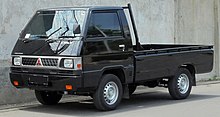
The Mitsubishi Filly L300 is the vehicle with the longest production run in Indonesia nether a single generation. Production started in 1982.
Mitsubishi through PT Krama Yudha Tiga Berlian Motors (KTB) has a long presence in Indonesia, simply their beginning truthful hitting was the Colt T120. This was a locally built version of the starting time generation Mitsubishi Delica, and from its introduction in the early 1970s it became a seminal vehicle. Information technology was mostly alone in its class and for a generation of Indonesians "Colt" became synonymous with minibus.[46] The T120 was finally discontinued in 1982 and replaced past the L300 (also based on the Delica); merely sales never reached their earlier highs. Mitsubishi finally revived the T120 nametag with a Mitsubishi-engined version of the Suzuki Bear Futura called the Mitsubishi Colt T120SS.[46] This alliance with Suzuki was an attempt to challenge the dominance of the Astra Group's Toyota, Daihatsu, and Isuzu.[47]
In 2014, Mitsubishi Motors Corporation announced to build an MMC-owned establish in Republic of indonesia. On 24 March 2015, the construction of a new manufacturing found in Cikarang, W Coffee was started. The found was designed with a maximum production chapters of 160,000 vehicles per year. PT Mitsubishi Motors Krama Yudha Indonesia, owned 51% past MMC was established to operate the constitute. The plant was started its operation in Apr 2017 by producing the Mitsubishi Pajero Sport. At the same time, the passenger cars and LCV operations were transferred from PT KTB to PT Mitsubishi Motors Krama Yudha Sales Indonesia (MMKSI).[48] [49] Mitsubishi Xpander was launched in August 2017 and nearly doubled Mitsubishi Motors sales in the state between 2017 and 2018 from 79,807 units to 142,861 units, emerging as the largest market for MMC. In 2019, MMKI surpassed Toyota Motor Manufacturing Republic of indonesia as the second largest car manufacturer in Indonesia by a production output of 193,954 units.
Suzuki [edit]
PT Suzuki Indomobil Motor is a joint venture between Suzuki Motor Corporation and the Indomobil Group. Until recently, the company was known as PT Indomobil Suzuki International. The visitor is located in Jakarta, Republic of indonesia and specialized in manufacturing Suzuki vehicles for the local market place. Their offset products were the ST10 Carry and Fronte LC20 of 1976. The Carry (presently replaced past the ST20) saw extensive use equally an Angkot.[50] Suzuki's first Indonesian activeness was in 1970 through its import firm PT Indohero Steel & Technology Visitor. Vi years later they had built their manufacturing facility in Jakarta, which is the oldest office of the Indomobil Group. Suzuki'due south sales rose exponentially in the mid-1980s as sales of minitrucks boomed and the Forsa/Swift was introduced: Suzuki Indonesia sold thirteen,434 vehicles in 1984, followed by 58,032 in 1985.[51]
Since 2004, Suzuki Republic of indonesia's APV (All Purpose Vehicle) budget MPV has been assembled exclusively in Indonesia. Designed in Japan, it is exported to numerous countries since 2005, to the Asean and beyond. Information technology is also available with Mitsubishi badging (as the "Maven").
Toyota [edit]

The Toyota Kijang is regarded as one of the most influential vehicles in Indonesian automotive industry.
PT Toyota Astra Motor (TAM) was founded in April 1971.[52] Vehicle production began in September 1974 at the PT Multi-Astra manufacturing subsidiary.[52] Toyota Indonesia'southward most famous product is the Kijang series of light trucks and vans. The Kijang, developed from the Philippine market Tamaraw Revo of 1976, has spawned an entire range of vehicles and is now built in a number of Asian countries including Bharat. The Kijang was one of a series of BUV's, or Basic Utility Vehicles, adult for developing markets past several global manufacturers in the 1960s and 1970s. The Kijang was very successful for Toyota Astra Motor, with the 100,000th example leaving the line in Feb 1985.[53] Production was almost entirely localized by the mid-eighties, with engine parts besides beginning to be produced in Indonesia by January 1985.[53] The Kijang likewise caused major upheavals amongst Indonesia's host of small trunk builders, as the torso was built to a whole new standard of quality and was offered straight by Toyota in a number of variants that had hitherto been the purview of the body builders.[36] The success of the Kijang was helpful for TAM equally the Crown, Mark 2, Country Cruiser, and Corona GL were all struggling in the market place in the kickoff half of the 1980s.[54]
The Country Cruiser dominated the "Jeep" category until the early 1980s, when lighter and more economic competitors began taking away its market share.[54] Unable to compete with the smaller offerings from Suzuki and Daihatsu, Toyota chose to non farther increase the local content levels of the Land Cruiser and had withdrawn it from the Indonesian market past 1986.[55] Currently Toyota Astra Motor'south production is carried out by PT Toyota Motor Manufacturing Indonesia (TMMIN), which consists of the erstwhile PT Multi-Astra likewise every bit PT Toyota Mobilindo (which was established in December 1976 with production commencing in May 1977).
Toyota and the Astra Group remains ascendant in Republic of indonesia, with their market share historically hovering from 35 to 50 per centum. They are bigger than the ii second biggest brands combined.[56]
Volkswagen [edit]

Volkswagen and their local partner PT Garuda Mataram was a major player until the mid-1970s but sales dropped precipitously in the latter one-half of the decade. In 1970, Volkswagen entered into a collaboration with Mercedes-Benz Distribution Indonesia to set up a manufacturing line in Tanjung Priok, Jakarta. The resulting company was called PT German Motor Manufacturing, with Garuda Mataram retaining the Volkswagen distribution rights. The partnership was dissolved in 1979 and Volkswagen went their own mode.[57] In or just earlier 1971 Republic of indonesia's Ground forces Strategic Control (Kostrad) took over the local Volkswagen operations as part of a tendency of direct government involvement in vehicle manufacturing (and manufacture in general).[58] Kostrad owned the Volkswagen agency through its Yayasan Dharma Putra business group, in partnership with 2 Chinese entrepreneurs.[59]
As with Volkswagen in the Philippines, sales dropped precipitously every bit the Japanese brands took hold. Past 1980, the locally developed Mitra project had come to an end as had assembly of the Beetle and the Typ 181 (Camat). Assembly of German-made Kombis and Transporters concluded in 1978.[60] Volkswagen replaced this on their Indonesian assembly lines with the Brazilian-made Volkswagen Combi Clipper. This remained Volkswagen's single model on offer in Indonesia until the centre of the 1980s.[61] By 1986, Volkswagens were no longer available in Indonesia, afterwards 13,162 Volkswagens had been assembled between 1976 and 1985.[62]
In 1998, a new distributor company called PT Garuda Mataram Motor was founded as a joint venture between Volkswagen Grouping and Indomobil Group. Currently, the company assembles and distributes Volkswagens passenger cars in Republic of indonesia.
Wuling [edit]
Wuling Motors (Republic of indonesia) is established in August 2015 as a subsidiary of SAIC-GM-Wuling Motorcar Visitor Limited (SGMW) with share limerick 50.1 per centum of SAIC (Shanghai Automotive International Corporation), 44 percent of GM Red china and 5.9 percent Guangxi Motorcar Group. The visitor has 60 hectares land in Cikarang, xxx hectares is for the manufacturing and xxx hectares is for supplier park for accessibility of the parts.[63] [64] [65]
Defunct manufacturers [edit]
General Motors (1927–2015) [edit]


A multifariousness of Full general Motors vehicles accept been sold in Indonesia, since the early days of the automobile there. Full general Motors vehicles have been represented in Indonesia since 1915. Full general Motors established their first local assembly operation (pictured) in Tanjung Priok in February 1927, as "KN Gaya Motor." The location was suitable as there was ample timber nearby, a necessity for motorcar trunk manufacture at the time.[33] In 1930, the visitor was renamed "N.V. Full general Motors Java Handel Maatschappij." Cars from their Jakarta factory were exported all across the region. After having been requisitioned by kingdom of the netherlands East Indies government in 1941, on 9 March 1942 all machines and equipment was destroyed to avoid it falling into the hands of the budgeted Japanese.[66] Two weeks later on the Japanese occupied the plant and interred all foreigners; on 31 December Full general Motors wrote off the entire enterprise.[66] The constitute was taken over past Toyota, and was used to assemble trucks for the military.[67]
In 1946 General Motors Overseas Operations established a Batavia Co-operative (later renamed "Dki jakarta Co-operative") to continue the pre-war activities, edifice almost 20,000 vehicles in the next half-dozen years.[66] Past 1953, activities had more often than not ended as Sukarno's pro-Chinese government took power. As of 1954 local partner PN Gaya Motor continued alone; the Indonesian regime took over the assets in April 1955. General Motors dissolved this paper operation a year later.[66] The regime-run operations did not take adept care of the found and 60 pct of the run-down assets were sold to PT Astra Motor (who, coincidentally, had gotten their start by being allowed to import 800 Chevrolet trucks in 1967) in 1969.[68] Astra had expected to sell Chevrolets simply were denied the contract and ended up importing Toyotas instead.[68]
A number of other, smaller companies proceeded to import and assemble a variety of General Motors products. Udatimex/Udatin has by and large handled Holdens, while Garuda Diesel/Garmak has sold Chevrolets, Opels, and the short-lived Morina national Basic Transportation Vehicle projection.[69] In the early 1970s, PT Kali Kuning (Jakarta) also imported Opels, specially the Rekord. Chevrolet, Holden, Opel, and Isuzu badging have been used, often placed on the aforementioned cars by the various importers.
- Holden
At the time of their 1959 introduction to Indonesia (although Holden-built Chevrolets first arrived in 1938) Holdens were sold past Gaya Motor. After gaining some popularity in the 1960s Udatimex (part of Fritz Eman's Udatinda Group in Djakarta) took over in 1970. Some other sub-company, PT Udatin, acted every bit the assembler. From 1954 until 1959, Holden Australia held the General Motors rights to all of Australia and Indonesia. The offset Holden to arrive in Indonesia was the FC series.[70] Sales increased considerably when the locally assembled Holden Gemini arrived in 1981. Other locally assembled Holdens were the Torana, Commodore, Statesman, Kingswood, and Premier. In the early 1970s, the HQ Statesman was sold as the "Chevrolet 350" by Garuda Diesel (Chevrolet's sole agent in Indonesia), while the Statesman was sold in parallel by Udatimex.
Garuda also developed an SUV version on the ground of the Isuzu KB, called the Holden Lincah. This was superficially very similar to the Isuzu Trooper, but had locally developed bodywork. A small number of Lincahs were exported to neighboring and Pacific Island countries in the middle of the 1980s.[71] A five-door version of the Lincah was also developed, called the Lincah Gama, but may never accept entered product. The Lincah Gama was one of the many cars Malcolm Bricklin planned on importing, following his success with the Yugo.[72] While the Gemini Diesel remained popular with taxi operators, with passenger car sales slowing downwards Udatimex close their doors in 1991, and regular imports of Holdens came to an end. The last new Holden introduced in Indonesia was the VL Calais. Even as the Indonesian automobile market place has grown rapidly after the Asian Crunch Holden did non return, as GMH'due south export manager Bob Branson decreed the stop of exports to countries with annual sales of less than 500 cars in 2001.[73]
- Opel
In January 1993 Full general Motors again began direct local operations every bit PT General Motor Buana Indonesia (GMBI) was formed, with a plant with 15,000 vehicle capacity in Bekasi, W Java.[66] threescore per centum of the company was held by GM, with the rest belonging to local partner PT Garmak Motor. In 1997 General Motors took full control of the visitor. The first locally made productof the new company was the Opel Vectra (1994), followed by the Opel Optima and the Opel Blazer in 1995.[66] Equally of 2002, the Chevrolet nameplate has replaced Opel in Republic of indonesia.[66] Opels had also been very pop before the state of war, with the Opel P4 being assembled in Tanjung Priok. A locally bodied 7-seater taxibus arrived in 1932; an ambulance version was added in 1933.[74] The taxi model was called Oplet (brusque for the trade proper noun "Opelette") - a name which was used for share taxis until the type was abolished in 1979.
- Chevrolet
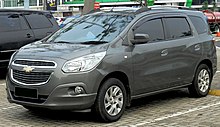
Chevrolet manufactured the Spin MPV in Bekasi, Indonesia betwixt 2013 and 2015.
Chevrolet was one of the nigh popular brands in Indonesia until the 1960s. In particular the 210-series sold well. After, the Chevrolet badge was mainly used on diverse Isuzu products like the Chevrolet LUV and Trooper.
In 2002, Chevrolet replaced Opel as GM's only marque in Indonesia. At the time, the locally assembled Opel Blazer was renamed to Chevrolet Blazer. Information technology was sold alongside Tavera, a rebadged Isuzu Panther and the imported Zafira. In 2005, GM ended Blazer production in Indonesia, effectively rendering their manufacturing plant in Bekasi as dormant. Since then, GM finer acts every bit an importer of Chevrolet-badged Daewoo cars from Thailand and Republic of korea.
In 2012, GM appear that it would reactivate the Bekasi plant to assemble a compact MPV, the Chevrolet Spin for Southeast Asian market. The 58,000 square meter found represents an investment of USD 150 meg, employs 700 people and was planned to produce xl,000 vehicles a year.[75] GM says that the Bekasi plant is a critical office of GM'south growth strategy in Indonesia and Southeast Asia. The plant's location fulfills GM'due south philosophy of "build where we sell and source where we build."[76] GM airtight the establish in 2015, citing low sales and rise costs.[77] [78] GM status in Republic of indonesia was reverted equally an importer.
In October 2019, Full general Motors Indonesia announced that it would leave the Indonesian market entirely by 31 March 2020.[79] [80] Later in February 2020 GM as well exited Thailand and Australia, leaving GM without any major presence in right-hand bulldoze markets.[81] [82]
Mazda (1985–1998) [edit]

Mazda MR90
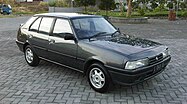
Mazda Baby Boomer

Mazda Vantrend
Mazda get-go entered the Indonesian market place in the 1960s as an imported brand. In 1985, Indomobil started manufacturing Mazda vehicles in Indonesia through its fully owned constitute and was distributed through PT National Motors Co. (now PT Unicor Prima Motor), another Indomobil subsidiary.[83] In 1989, Indomobil together with Sumitomo Corporation started PT Mazda Indonesia Manufacturing (MIM) plant through a joint venture.[84] The plant would industry the Mazda MR90, a car based on the 3rd generation Mazda 323 Familia. Information technology was designated as a 'people's automobile' to compete with Toyota Kijang. MR90 stands for 'Mobil Rakyat 1990', ('people's motorcar of the 1990s'), as the car was introduced effectually July 1990. To achieve a competitive price for the auto, Indomobil proposed to the government to lower the luxury goods taxation from 30% to 0-10%. The proposal was so unexpectedly rejected by the authorities, citing the absenteeism of a 'national car' regulation and the fact that the car is categorized as a sedan, which means information technology is considered every bit a luxury goods. Equally the result, sales were beneath expectations, since the car was significantly more than expensive than the Toyota Kijang.[85] The Mazda MR90 was later revised and renamed to Mazda Vantrend and Mazda Babe Boomer, hoping to improve sales. In 1998, PT MIM went bankrupt in the midst of Southeast Asian fiscal crisis and the establish in Tambun was sold to Suzuki.[85]
Between 1998 and 2006, Mazda cars were imported and distributed by PT Unicor Prima Motor before the distribution was taken over by Mazda Motor Corporation, creating PT Mazda Motor Indonesia equally the sole importer and distributor.[86] The handover marked the finish of production of the locally assembled Mazda E2000 which was introduced in 1996,[87] and likewise saw PT Unicor Prima Motor transformed into Chery car distributor.[88] Mazda Motor Republic of indonesia solely relied on importing its line-up of vehicles from Nihon, Thailand and the Philippines, except the Suzuki-made Mazda VX-1 (a rebadged Ertiga).
In 2017, Mazda Motor Corporation transferred its operations in Indonesia to PT Eurokars Motor Indonesia.[89] Mazda remained an import brand, sourcing Mazda vehicles from Japan, Thailand and Malaysia.
Timor (1996–2000) [edit]
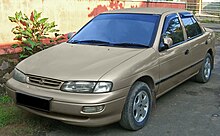
In 1996, the Ministry of Manufacture and Merchandise announced a president teaching (Inpress) No. 2 yr 1996 regarding the development of the national car industry, instructing the Government minister of Manufacture and Merchandise, the Minister of Finance, and the State Government minister for Mobilization of Investment Funds to immediately realize the national auto industry. It also mentioned the pioneer company to do then is PT Timor Putra Nasional (TPN), owned by Hutomo Mandala Putra, the son of president Suharto. TPN is the only car manufacturer to be declared gratuitous from luxury goods tax.[90] TPN partnered with Kia Motors to import Kia Sephia sedan every bit the Timor S515i past a semi knock downwardly (SKD) scheme. The sedan was introduced on 8 July 1996. Due to its depression price, the car quickly gained some traction in Indonesia.
However, several countries such as Nihon, the United States, and the European Communities immediately protested the national car program and privilege of Timor cars. A lawsuit was and then brought to the World Trade Organization (WTO). The program was declared incompatible with WTO rules by Dispute Settlement Body of WTO in 1998. It was proved that the "national car program" violated the World Merchandise System Agreement on Subsidies and Countervailing Duties because the exemption from taxes is a subsidy contingent upon the apply of domestic goods.[91] As such, the visitor had to end its operations by a presidential decree (Keppres) No 20 1998 issued on 21 Jan 1998.
Volvo [edit]
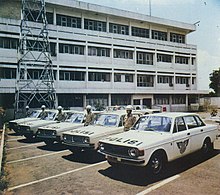
A fleet of Volvo 144's being used every bit law cars in 1976, a issue of Liem'southward close relationship with the Indonesian government.
Volvo automobiles have been regularly imported to Indonesia since 1971, when Liem Sioe Liong's PT Central Sole Agency gained the concession.[92] By 1975, industrial policy dictated that the cars be assembled locally and Liem responded by creating a joint venture chosen PT Salim Jaya Motor, operated by his son Albert. They assembled two Volvo models and had a steady market in the form of military and authorities officials. The venture lost money though, due to the difficulties of collecting money from government officials during the Suharto era. A pocket-size number of heavy trucks were also imported. Even with government favor, sales were never very large: between 1976 and 1985, simply 1015 Volvo passenger cars (and 201 heavy trucks) were assembled in Republic of indonesia.[93]
The Salim Group notwithstanding imports Volvo trucks, buses, and structure equipment equally of 2017, through a company chosen PT Indotruck Utama. Since January 2017, Garansindo is the sole importer and distributor of Volvo automobiles in Republic of indonesia.[94]
Luxury goods tax classification [edit]
| | This section needs to exist updated. (November 2021) |

Republic of indonesia imposes luxury appurtenances taxation (Indonesian: Pajak Penjualan atas Barang Mewah (PPnBM)) based on engine displacement and body type.[95] While dimensions aren't used in the classification, sedan and station wagon body type are taxed differently. This tax scheme was phased out in October 2021 in favour of an emission-based nomenclature.[96]
A vehicle is considered a sedan if the rear window is not a role of the rear torso opening.
- Classification used until October 2021
| Luxury goods tax percentage | Engine deportation | Layout | Body type | Examples |
|---|---|---|---|---|
| 0% | master article: Low Toll Dark-green Car (Indonesia) | Toyota Agya, Toyota Calya, Honda Brio Satya | ||
| x% | <1.5 L | FWD or RWD | except sedan and station wagon | Toyota Avanza, Honda 60 minutes-V 1.5, Honda Brio RS |
| whatsoever chapters | whatever layout | minibus with 10-15 passengers capacity | Kia Grand Sedona, Hyundai H-1 | |
| xx% | i.5–3.0 L (petrol) 1.5–2.5 L (diesel) | FWD or RWD | except sedan and station railroad vehicle | Toyota Kijang Innova, Honda Hour-V 1.8, Toyota Fortuner 2.iv 4x2 |
| whatever capacity | any layout | double cabin pick-up | Toyota Hilux, Mitsubishi Triton, Isuzu D-Max | |
| 30% | <ane.5 50 | FWD or RWD | sedan and station wagon | Toyota Vios, Honda City, Honda Borough Turbo |
| 4WD or AWD | except sedan and station railroad vehicle | Audi Q3, Suzuki Jimny | ||
| forty% | one.5–3.0 L (petrol) | FWD or RWD | sedan and station wagon | Toyota Corolla Altis, Toyota Camry, Honda Accord, Mazda 6 |
| 1.v–two.5 L (diesel) | FWD or RWD | sedan and station wagon | BMW 320d, BMW 520d | |
| 2.5–3.0 L (petrol) | FWD or RWD | except sedan and station wagon | Toyota Fortuner 2.seven 4x2 | |
| 1.v–ii.5 L (diesel) | 4WD or AWD | whatever torso type | Toyota Fortuner 2.4 4x4, Mitsubishi Pajero Sport 4x4, Hyundai Palisade AWD | |
| 1.v–3.0 50 (petrol) | 4WD or AWD | any body type | Mazda CX-9 AWD, Audi A4 | |
| 125% | >two.5 L (diesel fuel) iii.0 L (petrol) | whatsoever layout | any body type | Toyota Land Cruiser, Lexus LX570, Toyota Alphard 3.v |
Automobiles currently manufactured in Indonesia [edit]
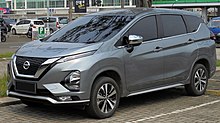
Models that are both sold locally and exported are stated in italic. Excluding models for exports only (not sold locally), e.g. Mazda Bongo.
BMW: 2 Series Gran Coupé, 3 Serial, 5 Series, 7 Series, X1, X3, X5, X7
Chery: Tiggo 4 Pro, Tiggo 7 Pro, Tiggo 8 Pro
Daihatsu: Ayla, Gran Max, Luxio, Rocky, Sigra, Terios, Xenia
DFSK: Gelora, Glory 560, Celebrity 580/Celebrity i-Auto, Supercab
Honda: Brio, BR-V, City Hatchback, CR-V, Hour-V, Mobilio
Hyundai: Creta
Ioniq: v
Isuzu: Traga
Mercedes-Benz: A-Class, C-Course, East-Class, S-Form, V-Form, GLA-Class, GLC-Class, GLE-Form, GLS-Class
MINI: Cooper, Countryman
Mitsubishi: Pajero Sport, Xpander/Xpander Cantankerous
Nissan: Livina
Suzuki: APV, Carry, Ertiga, XL7
Toyota: Agya, Avanza/Veloz, Calya, Fortuner, Kijang Innova, Raize, Rush, Sienta, Vios, Yaris
Volkswagen: Tiguan Allspace
Wuling: Almaz, Confero, Cortez, Formo
Active manufacturing facilities [edit]
Automotive manufacturing facilities in Indonesia is currently focused in the western part of Java, mainly in the Djakarta–Cikampek toll road corridor in Bekasi and Karawang, where few industrial estates are located there.
| Listing of agile automobile manufacturing plants in Republic of indonesia | ||||||||
|---|---|---|---|---|---|---|---|---|
| Proper noun | Founded | Location | Product | Exports | ||||
| Operational telescopic | Make | Models produced (since 2019) | Installed capacity | Book (2019) | ||||
| Astra Daihatsu Motor (ADM) Sunter Associates Establish | 1998 | Sunter, North Jakarta, DKI Dki jakarta | Manufacturing | Daihatsu |
| 330,000 | 525,483 | Aye |
| Toyota |
| |||||||
| Mazda |
| |||||||
| Astra Daihatsu Motor (ADM) Karawang Assembly Found | 2013 | Karawang Regency, W Java | Daihatsu |
| 200,000 | |||
| Toyota |
| |||||||
| Gaya Motor | 1969 | Sunter, North Djakarta, DKI Jakarta | Manufacturing | Isuzu |
| 50,000 | 24,446 (incl. Isuzu production in IAMI Karawang) | Yes |
| Assembly | UD Trucks |
| ane,511 | No | ||||
| BMW |
| 2,337 | ||||||
| MINI |
| 263 | ||||||
| Handal Indonesia Motor (HIM) | 1995 | Pondok Ungu, Bekasi Urban center, West Coffee | Assembly | Hyundai |
| 10,000 | iii,789 | Aye |
| Chery |
| No | ||||||
| Hino Motor Manufacturing Indonesia (HMMI) | 2003 | Purwakarta Regency, W Coffee | Manufacturing | Hino |
| 75,000 | 32,425 | Yes |
| Toyota |
| |||||||
| Honda Prospect Motor (HPM) Establish one | 2003 | Karawang Regency, Due west Coffee | Manufacturing | Honda |
| 80,000 | 133,247 | Yeah |
| Honda Prospect Motor (HPM) Found 2 | 2014 |
| 120,000 | |||||
| Hyundai Motor Manufacturing Indonesia (HMMI) | 2022 | Cikarang, Bekasi Regency, Westward Java | Manufacturing | Hyundai |
| 150,000 | - | Yeah |
| Ioniq |
| |||||||
| Isuzu Astra Motor Indonesia (IAMI) | 2015 | Karawang Regency, Westward Java | Manufacturing | Isuzu |
| 55,000 | 24,446 (incl. Isuzu production in Gaya Motor) | Yes |
| Krama Yudha Ratu Motor (KRM) | 1973 | Pulo Gadung, East Jakarta, Dki jakarta | Manufacturing | Mitsubishi Fuso |
| Due north/A | 43,965 | Aye |
| Mercedes-Benz Indonesia (MBI) | 1978 | Wanaherang, Bogor Regency, West Java | Associates | Mercedes-Benz PC |
| N/A | N/A | No |
| Mercedes-Benz CV |
| |||||||
| Mitsubishi Motors Krama Yudha Indonesia (MMKI) | 2017 | Cikarang, Bekasi Regency, W Java | Manufacturing | Mitsubishi Motors |
| 220,000 | 193,954 | Yep |
| Nissan |
| No | ||||||
| National Assemblers Pulogadung Plant | 1971 | Pulo Gadung, East Jakarta, DKI Jakarta | Assembly | Renault |
| xv,000 | N/A | No |
| National Assemblers Purwakarta Plant | 2019 | Purwakarta Regency, West Java | Volkswagen |
| 5,000 | |||
| Nissan Motor Indonesia (NMI) Found ane | 2003 | Purwakarta Regency, West Coffee | Engine Manufacturing | Nissan |
| 130,000 | 180 | Yes |
| Nissan Motor Indonesia (NMI) Plant 2 | 2014 | Datsun |
| 50,000 | 4,516 | No | ||
| SGMW Motor Republic of indonesia (SGMW) | 2017 | Cikarang, Bekasi Regency, West Java | Manufacturing | Wuling |
| 120,000 | 24,980 | Yep |
| Chevrolet |
| |||||||
| Sokonindo Automobile (DFSK) | 2017 | Cikande, Serang Regency, Banten | Manufacturing | DFSK |
| fifty,000 | 4,069 | Yeah |
| Solo Manufaktur Kreasi (Esemka) | 2019 | Sambi, Boyolali Regency, Central Java | Associates | Esemka |
| 12,000 | N/A | No |
| Suzuki Indomobil Motor (SIM) Plant one | 1991 | Tambun, Bekasi City, West Java | Manufacturing | Suzuki |
| 120,000 | 124,658 | Yes |
| Suzuki Indomobil Motor (SIM) Plant 2 | 2015 | Cikarang, Bekasi Regency, West Java |
| 120,000 | ||||
| Toyota Motor Manufacturing Indonesia (TMMIN) Plant 1 Karawang | 1998 | Karawang Regency, W Coffee | Manufacturing | Toyota |
| 130,000 | 166,600 | Aye |
| Toyota Motor Manufacturing Republic of indonesia (TMMIN) Plant 2 Karawang | 2013 |
| 120,000 | |||||
Statistics [edit]
Historical statistics [edit]
Sales rank [edit]
| Meridian 10 best-selling models in Indonesia (passenger and light commercial vehicles), 1990–2021 Source: BSCB,[97] GAIKINDO[vii] | ||||||||||
|---|---|---|---|---|---|---|---|---|---|---|
| Year | Models and ranking | |||||||||
| 1st | second | 3rd | 4th | 5th | 6th | 7th | 8th | 9th | tenth | |
| 1990 | Toyota Kijang | Daihatsu Zebra | Suzuki Deport | Suzuki Katana | Honda Borough | Toyota Corolla | Daihatsu Rocky | Honda Accord | Daihatsu Hiline | Mitsubishi Filly L300 |
| 1991 | Toyota Kijang | Suzuki Carry | Daihatsu Zebra | Mitsubishi Colt T120SS | Isuzu Panther | Suzuki Katana | Daihatsu Rocky | Honda Civic | Daihatsu Hiline | Toyota Starlet |
| 1992 | Toyota Kijang | Suzuki Conduct | Isuzu Panther | Daihatsu Zebra | Mitsubishi Colt T120SS | Suzuki Katana | Daihatsu Rocky | Toyota Corolla | Honda Civic | Suzuki Vitara |
| 1993 | Toyota Kijang | Suzuki Carry | Isuzu Panther | Daihatsu Zebra | Mitsubishi Colt T120SS | Mitsubishi Filly L300 | Suzuki Katana | Suzuki Vitara | Daihatsu Rocky | Toyota Corolla |
| 1994 | Toyota Kijang | Suzuki Deport | Isuzu Panther | Daihatsu Zebra | Daihatsu Feroza | Mitsubishi Colt T120SS | Mitsubishi Colt L300 | Suzuki Vitara | Toyota Corolla | Honda Accord |
| 1995 | Toyota Kijang | Suzuki Carry | Isuzu Panther | Daihatsu Zebra | Daihatsu Feroza | Mitsubishi Colt T120SS | Mitsubishi Colt L300 | Suzuki Vitara | Toyota Corolla | Daihatsu Hiline |
| 1996 | Toyota Kijang | Suzuki Carry | Isuzu Panther | Daihatsu Zebra | Mitsubishi Filly T120SS | Mitsubishi Colt L300 | Suzuki Vitara | Timor S5 | Toyota Corolla | Suzuki Katana |
| 1997 | Toyota Kijang | Isuzu Panther | Suzuki Carry | Daihatsu Zebra | Timor S5 | Mitsubishi Filly T120SS | Mitsubishi Colt L300 | Suzuki Baleno | Suzuki Vitara | Suzuki Katana |
| 1998 | Toyota Kijang | Isuzu Panther | Suzuki Carry | Timor S5 | Daihatsu Zebra | Mitsubishi Colt L300 | Mitsubishi Colt T120SS | Suzuki Baleno | Daihatsu Feroza | Ford Laser |
| 1999 | Toyota Kijang | Isuzu Panther | Suzuki Comport | Mitsubishi Kuda | Daihatsu Taruna | Mitsubishi Colt L300 | Mitsubishi Colt T120SS | Timor S5 | Opel Blazer | Suzuki Vitara |
| 2000 | Toyota Kijang | Suzuki Carry | Isuzu Panther | Daihatsu Taruna | Mitsubishi Kuda | Mitsubishi Colt L300 | Toyota Soluna | Timor S5 | Suzuki Baleno | Daihatsu Zebra |
| 2001 | Toyota Kijang | Suzuki Carry | Isuzu Panther | Mitsubishi Colt L300 | Mitsubishi Colt T120SS | Daihatsu Taruna | Daihatsu Zebra | Toyota Soluna | Mitsubishi Kuda | Honda CR-V |
| 2002 | Toyota Kijang | Suzuki Carry | Isuzu Panther | Mitsubishi Colt T120SS | Mitsubishi Colt L300 | Mitsubishi Kuda | Daihatsu Zebra | Daihatsu Taruna | Toyota Soluna | Honda CR-V |
| 2003 | Toyota Kijang | Suzuki Carry | Mitsubishi Colt T120SS | Isuzu Panther | Mitsubishi Filly L300 | Daihatsu Zebra | Honda CR-5 | Mitsubishi Kuda | Honda City | Daihatsu Taruna |
| 2004 | Toyota Kijang/ Kijang Innova | Suzuki Carry | Toyota Avanza | Honda Jazz | Daihatsu Xenia | Mitsubishi Colt T120SS | Daihatsu Zebra | Mitsubishi Colt L300 | Isuzu Panther | Toyota Vios |
| 2005 | Toyota Kijang Innova | Toyota Avanza | Suzuki Deport | Honda Jazz | Suzuki APV | Daihatsu Xenia | Mitsubishi Colt T120SS | Mitsubishi Colt L300 | Isuzu Panther | Daihatsu Zebra |
| 2006 | Toyota Avanza | Toyota Kijang Innova | Suzuki Carry | Daihatsu Xenia | Honda Jazz | Suzuki APV | Isuzu Panther | Toyota Yaris | Mitsubishi Colt L300 | Daihatsu Zebra |
| 2007 | Toyota Avanza | Toyota Kijang Innova | Daihatsu Xenia | Suzuki Carry | Daihatsu Terios | Toyota Blitz | Honda Jazz | Nissan Livina | Suzuki APV | Mitsubishi Filly L300 |
| 2008 | Toyota Avanza | Toyota Kijang Innova | Daihatsu Xenia | Daihatsu Gran Max | Nissan Livina | Honda Jazz | Suzuki Carry | Suzuki APV | Honda CR-5 | Mitsubishi Colt L300 |
| 2009 | Toyota Avanza | Daihatsu Xenia | Toyota Kijang Innova | Suzuki Bear | Honda Jazz | Daihatsu Gran Max | Nissan Livina | Daihatsu Terios | Toyota Rush | Suzuki APV |
| 2010 | Toyota Avanza | Daihatsu Xenia | Toyota Kijang Innova | Suzuki Carry | Daihatsu Gran Max | Nissan Livina | Honda Jazz | Mitsubishi Colt L300 | Toyota Blitz | Suzuki APV |
| 2011 | Toyota Avanza | Daihatsu Xenia | Toyota Kijang Innova | Suzuki Comport | Nissan Livina | Daihatsu Gran Max | Mitsubishi Filly L300 | Toyota Rush | Mitsubishi T120SS | Daihatsu Terios |
| 2012 | Toyota Avanza | Daihatsu Xenia | Toyota Kijang Innova | Daihatsu Gran Max | Suzuki Deport | Nissan Livina | Suzuki Ertiga | Toyota Rush | Toyota Yaris | Mitsubishi Colt L300 |
| 2013 | Toyota Avanza | Daihatsu Xenia | Toyota Kijang Innova | Daihatsu Gran Max | Suzuki Ertiga | Suzuki Deport | Nissan Livina | Toyota Blitz | Mitsubishi Colt T120SS | Honda Jazz |
| 2014 | Toyota Avanza | Honda Mobilio | Toyota Agya | Daihatsu Gran Max | Toyota Kijang Innova | Suzuki Carry | Suzuki Ertiga | Daihatsu Xenia | Daihatsu Ayla | Mitsubishi Colt T120SS |
| 2015 | Toyota Avanza | Daihatsu Gran Max | Toyota Agya | Suzuki Carry | Honda Brio | Toyota Kijang Innova | Honda HR-V | Daihatsu Xenia | Daihatsu Ayla | Suzuki Ertiga |
| 2016 | Toyota Avanza | Toyota Kijang Innova | Daihatsu Gran Max | Toyota Calya | Honda Brio | Toyota Agya | Daihatsu Xenia | Honda Hr-V | Daihatsu Ayla | Honda BR-V |
| 2017 | Toyota Avanza | Toyota Calya | Toyota Kijang Innova | Daihatsu Gran Max | Honda Brio | Daihatsu Sigra | Honda HR-V | Daihatsu Xenia | Suzuki Ertiga | Suzuki Carry |
| 2018 | Toyota Avanza | Mitsubishi Xpander | Toyota Calya | Toyota Kijang Innova | Honda Brio | Daihatsu Gran Max | Toyota Blitz | Daihatsu Sigra | Suzuki Carry | Honda Hr-V |
| 2019 | Toyota Avanza | Honda Panache | Mitsubishi Xpander | Toyota Rush | Toyota Calya | Suzuki Acquit | Toyota Kijang Innova | Daihatsu Gran Max | Daihatsu Sigra | Mitsubishi Filly L300 |
| 2020 | Honda Panache | Suzuki Carry | Toyota Avanza | Daihatsu Gran Max | Toyota Blitz | Toyota Kijang Innova | Mitsubishi Xpander | Toyota Calya | Daihatsu Sigra | Mitsubishi Filly L300 |
| 2021 | Toyota Avanza | Mitsubishi Xpander | Daihatsu Gran Max | Suzuki Carry | Toyota Blitz | Toyota Kijang Innova | Honda Panache | Daihatsu Sigra | Toyota Calya | Mitsubishi Colt L300 |
| 1st | 2nd | 3rd | 4th | fifth | 6th | 7th | eighth | 9th | tenth | |
| Indigenous brand Imported vehicles Partially imported vehicles (select trims/models) Note: 1. Suzuki Vitara includes Escudo and Sidekickii. Suzuki Conduct not including Mega Carry3. Nissan Livina includes two-row Livina and three-row Thousand Livina4. Honda Brio includes LCGC Panache Satya5. Mitsubishi Xpander includes Xpander Cross | ||||||||||
Encounter besides : Acknowledged models in
| ||||||||||
Industry data [edit]
| Calendar Yr | Wholesales | Retail Sales | Product | Exports (CBU)[98] |
|---|---|---|---|---|
| 1990[99] | 223,547 | not available | not available | not available |
| 1991[99] | 215,644 | |||
| 1992[100] | 150,221 | |||
| 1993[100] | 184,977 | |||
| 1994[101] | 279,228 | |||
| 1995[101] | 326,965 | |||
| 1996[102] | 278,416 | |||
| 1997[103] | 336,968 | |||
| 1998[103] | 53,412 | |||
| 1999[104] | 84,928 | |||
| 2000[105] | 289,747 | |||
| 2001[105] | 270,920 | |||
| 2002[105] | 288,553 | |||
| 2003[106] | 320,457 | |||
| 2004[107] | 441,912 | nine,572 | ||
| 2005 | 533,917 | 17,805 | ||
| 2006 | 318,904 | thirty,974 | ||
| 2007 | 433,341 | lx,267 | ||
| 2008 | 603,774 | 100,982 | ||
| 2009 | 486,088 | 464,816 | 56,669 | |
| 2010 | 764,710 | 702,508 | 85,769 | |
| 2011 | 894,164 | 890,559 | 838,388 | 107,932 |
| 2012 | ane,116,230 | 1,098,331 | ane,052,895 | 173,371 |
| 2013 | 1,229,811 | 1,218,817 | 1,206,368 | 170,958 |
| 2014 | 1,208,019 | 1,195,409 | 1,298,523 | 202,273 |
| 2015 | 1,013,518 | one,031,842 | 1,098,780 | 207,961 |
| 2016 | ane,062,694 | one,073,547 | 1,178,346 | 194,395 |
| 2017 | 1,077,365 | 1,067,396 | 1,217,518 | 231,169 |
| 2018 | 1,151,284 | 1,152,641 | i,343,743 | 264,553 |
| 2019 | 1,030,126 | 1,043,017 | one,286,848 | 332,023 |
| 2020 | 532,027 | 578,327 | 690,150 | 232,175 |
| 2021 | 887,202 | 863,348 | 1,121,967 | 294,639 |
[vii] [108]
including passenger cars, light commercial vehicles and heavy commercial trucks
2019 statistics [edit]
Production and exports by manufacturer [edit]
| Rank | Manufacturing plant | Product | Share | Exports |
|---|---|---|---|---|
| ane | Astra Daihatsu Motor | 525,483 | 40.8% | 123,227 |
| 2 | Mitsubishi Motors Krama Yudha Indonesia | 193,954 | xv.1% | 64,714 |
| 3 | Toyota Motor Manufacturing Indonesia | 166,600 | 12.9% | 89,205 |
| 4 | Honda Prospect Motor | 133,247 | ten.4% | vi,847 |
| v | Suzuki Indomobil Motor | 124,658 | ix.vii% | 39,613 |
| half dozen | Krama Yudha Ratu Motor (Fuso) | 43,965 | iii.4% | 0 |
| seven | Hino Motors Manufacturing Indonesia | 32,425 | 2.5% | 2,310 |
| 8 | SGMW Motor Republic of indonesia | 24,980 | one.ix% | 2,696 |
| 9 | Isuzu Astra Motor Indonesia | 24,446 | ane.9% | 0 |
| x | Nissan Motor Indonesia | 4,696 | 0.four% | 0 |
| others | 12,394 | 1.0% | 3,411 | |
| Full | ane,286,848 | 100% | 332,023 | |
Sales by make [edit]
| Rank | Brand | Sales | Marketplace share |
|---|---|---|---|
| 1 | Toyota | 331,797 | 32.ii% |
| 2 | Daihatsu | 177,284 | 17.2% |
| iii | Honda | 137,339 | 13.3% |
| iv | Mitsubishi Motors | 119,011 | 11.6% |
| 5 | Suzuki | 100,383 | nine.7% |
| six | Mitsubishi Fuso | 42,754 | four.ii% |
| 7 | Hino | 31,068 | 3.0% |
| eight | Isuzu | 25,270 | 2.5% |
| nine | Wuling | 22,343 | 2.two% |
| 10 | Nissan | 12,302 | 1.2% |
| others | thirty,575 | 2.ix% | |
| Total | 1,030,126 | 100% | |
Sales by automotive group [edit]
| Rank | Brand | Sales | Market place share |
|---|---|---|---|
| 1 | Toyota Grouping | 541,574 | 52.six% |
| ii | Renault-Nissan-Mitsubishi Alliance | 138,079 | xiii.4% |
| 3 | Honda | 137,339 | 13.3% |
| four | Suzuki | 100,383 | 9.seven% |
| 5 | Daimler Group | 45,966 | 4.5% |
| 6 | Isuzu | 25,270 | two.5% |
| 7 | SAIC-GM-Wuling | 23,872 | ii.3% |
| others | 17,643 | 1.vii% | |
| Total | 1,030,126 | 100% | |
Sales by car models [edit]
| Rank | Model | Sales | Share | Group | Segment |
|---|---|---|---|---|---|
| 1 | Toyota Avanza | 86,374 | 8.4% | Toyota Group | B-segment 3-row mini MPV |
| 2 | Honda Brio | 70,344 | 6.viii% | Honda | A-segment hatchback (Satya variant included in LCGC programme) |
| three | Mitsubishi Xpander | 62,666 | 6.1% | Mitsubishi Motors | B-segment 3-row compact MPV |
| iv | Toyota Rush | 61,569 | 6.0% | Toyota Group | B-segment iii-row mini SUV |
| 5 | Toyota Calya | 54,569 | 5.3% | Toyota Group | A-segment three-row mini MPV (LCGC) |
| vi | Toyota Kijang Innova | 52,981 | five.1% | Toyota Group | C-segment 3-row compact MPV |
| 7 | Daihatsu Sigra | 52,283 | five.1% | Toyota Grouping | A-segment 3-row mini MPV (LCGC) |
| eight | Toyota Agya | 25,082 | 2.4% | Toyota Group | A-segment hatchback (LCGC) |
| 9 | Suzuki Ertiga | 24,549 | ii.four% | Suzuki | B-segment 3-row meaty MPV |
| ten | Daihatsu Terios | 22,960 | 2.2% | Toyota Grouping | B-segment iii-row mini SUV |
excluding calorie-free commercial vehicles and heavy commercial trucks
References [edit]
- ^ Hidayat, Ali Akhmad Noor (29 March 2018). "Menperin: Industri Otomotif Sumbang x,16 Persen ke PDB". Tempo . Retrieved iii February 2020.
- ^ "Industri Otomotif Indonesia Untung 2,5 Miliar Dolar AS" [Indonesian automotive industry gained 2.5 billion USD surplus]. 18 September 2014.
- ^ "Globe'southward Top 20 Largest Rider Car-Producing Countries In 2017 (Million Units)". CEOWORLD magazine. 20 November 2018. Retrieved 7 September 2019.
- ^ "Automotive Manufacturing Industry Republic of indonesia - Car Sales | Indonesia Investments". www.republic of indonesia-investments.com . Retrieved 11 May 2020.
- ^ Dem, Bart; Scenes i, tInternational Street (9 January 2016). "Car cultures effectually the world: Bali, Indonesia". carsalesbase.com . Retrieved 11 May 2020.
- ^ "Indonesia Automotive Industry Outlook 2020" (PDF). Ipsos.
- ^ a b c d "Indonesian Machine Industry Data". files.gaikindo.or.id . Retrieved 7 September 2019.
- ^ Semuels, Alana (6 November 2017). "Why Aren't U.South. Cars Pop in Japan?". The Atlantic . Retrieved six June 2020.
- ^ "Changing Features of the Car Manufacture in Asia: Comparison of Production, Trade and Marketplace Structure in Selected Countries" (PDF) (pdf). Archived (PDF) from the original on 7 Dec 2017. Retrieved 19 June 2021.
- ^ "Astra International". www.astra.co.id . Retrieved 1 February 2020.
- ^ a b c Luhulima, James (2012). Sejarah Mobil & Kisah Kehadiran Mobil di Negeri Ini [History of Cars & The Story of the Presence of Cars in this Country] (in Indonesian). Jakarta: Kompas Penerbit Buku. p. sixteen. ISBN978-979-709-648-9.
- ^ "Inilah 3 Provinsi dengan Penjualan Mobil Terbesar 2018". Tempo. 29 March 2019. Retrieved 25 Feb 2020.
- ^ Media, Kompas Cyber (9 Baronial 2018). "Hampir 40 Persen Penjualan Mobil Nasional Hanya di Jakarta-Jabar" [Almost twoscore percent of national car sales were from Djakarta and West Coffee]. KOMPAS.com (in Indonesian). Retrieved 25 Feb 2020.
- ^ Idris, Muhammad. "2017, Warga Jabar dan Jakarta Paling Banyak Beli Mobil Baru" [2017, Westward Java and Jakarta citizens bought the most new cars]. detikoto (in Indonesian). Retrieved 25 Feb 2020.
- ^ Luhulima, James (25 March 2014), Sejarah Mobil & Kisah Kehadiran Mobil Di Negeri Ini (in Indonesian), Jakarta, Indonesia: Kompas, p. 16
- ^ a b Adriana, Elisabeth; Tu, Chaw-Hsia, eds. (2014), Republic of indonesia-Taiwan Economic Cooperation Arrangement: Is it Feasible?, Djakarta, Republic of indonesia: Yayasan Pustaka Obor Indonesia, p. 41, ISBN978-979-461-858-5
- ^ a b c Witoelar, Wimar (1983), Odata, Kōnosuke (ed.), "Coincident Firm Development in the Motor Industry in Republic of indonesia", The Motor Vehicle Industry in Asia: A Study of Ancillary Firm Development, Singapore: NUS Press, pp. 18–19, ISBN978-9971690571
- ^ Harjanto, Ismu (June 1981). "Tahun 1984 Indonesia diharapkan sudah dapat membuat mobil sendiri" [Indonesia is expected to make its own machine by 1984]. Andalan (in Indonesian). Vol. I, no. 3. PT New Ratna Motor. p. 8.
- ^ a b Doner, Richard F. (1991), Driving a Deal: Automobile Industrialization and Japanese Firms in Southeast Asia , Berkeley, Los Angeles, and Oxford: Academy of California, pp. 151, 157, ISBN0-520-06938-2
- ^ Doner, p. 152
- ^ a b Salamun, Untung (March 1984). "MPU larisnya seperti pisang goreng" [MPUs are selling like fried bananas]. MOB: Mekanik Populer & Mobil (in Indonesian). Jakarta, Indonesia: P.T. Dinamika Dharma: 47. ISSN 0125-9520.
- ^ Hidayat, Arief (1 December 1982). "Daftar harga: mobil diesel" [Price list: diesel vehicles]. Mobil & Motor (in Indonesian). Vol. 12, no. 11. PT Inscore Indonesia. p. 67. ISSN 0047-7591.
- ^ Purwoto, Breyman (1 December 1982). "Nasib mobil berbahanbakar solar" [The fate of diesel cars]. Mobil & Motor (in Indonesian). Vol. 12, no. eleven. PT Inscore Indonesia. pp. 7–8. ISSN 0047-7591.
- ^ "detik Finance : Mobil Murah Nasional Rp 39,99 Juta Meluncur Januari 2012" [National Cheap Auto stock slides by Rp 39.99 one thousand thousand in January 2012]. Detik Finance (in Indonesian). 23 December 2011. Retrieved viii April 2013.
- ^ "Peraturan Pemerintah Republik Indonesia nomor 41 tahun 2013" [Indonesian Republic, Authorities Regulation number 41 of 2013] (PDF) (in Indonesian). Retrieved 7 June 2013.
- ^ "Bea Masuk Barang Impor Naik – GAIKINDO". www.gaikindo.or.id . Retrieved 21 July 2020.
- ^ "Tata Cara dan Menghitung Biaya Bea Masuk Impor Kendaraan". otopedia.com . Retrieved 21 July 2020.
- ^ "UPDATE 1-Indonesia raises import taxes on 1,000-plus goods to support rupiah | Reuters".
- ^ https://world wide web.indonesia-investments.com/news/todays-headlines/indonesian-demand-for-imported-cbu-cars-still-strong/item6501?
- ^ "GAIKINDO History". GAIKINDO. Retrieved 13 December 2017.
- ^ Witoelar, p. 32
- ^ a b Borsuk, Richard; Chang, Nancy (23 May 2014). Liem Sioe Liong's Salim Group: The Business Pillar of Suharto's Indonesia. Singapore: Institute of Southeast Asian Studies. p. 241. ISBN978-981-4459-57-0.
- ^ a b c "Kota, Asap Knalpot, dan Cinta nan Rumit..." [Metropolis, Exhaust Smoke, and Troubled Love...]. Kliping (in Indonesian). DKI Jakarta. 2 May 2016. Archived from the original on 1 Jan 2018.
- ^ Ekonugroho, Muhammad (June 1981). "Kendaraan Jepang: Andalan dunia di Jalan Raya" [Japanese Vehicles: Mainstays of the globe's Highways]. Andalan (in Indonesian). Vol. I, no. 3. PT New Ratna Motor. p. ix.
- ^ a b Ayu Kusumawardhani, Citra (4 June 2016). "What Kind of Business does an Sectional Licensee Amanuensis (Agen Tunggal Pemegang Merk or "ATPM") Actually Do?". Hanafiah Ponggawa & Partners. Archived from the original on xviii Oct 2016.
- ^ a b Mustmar, Andi (ii November 1992). "Tanpa spesialisasi, ya merugi" [Specialize or exist lost]. Intan Motor (in Indonesian). Vol. Half dozen, no. 113. Jakarta: Yayasan Beraya Press. p. 42. ISSN 0215-7713.
- ^ "Sejarah Motor BMW di Indonesia" [History of BMW motorcycles in Republic of indonesia]. Modifikasi Motor Klasik (in Indonesian). 27 January 2010. Retrieved 30 July 2017.
- ^ a b Thieme, Ulrich. "CKD: Indonesien". E12.de (in German). Retrieved thirty July 2017.
- ^ "BMW Group To Establish Subsidiary in Indonesia". BMW Group. 29 January 2001.
- ^ a b Salamun, p. 47
- ^ "Daihatsu, Toyota Announce Dual-model Debut for Indonesia —Innovative Small Car Aimed at Creating New Segment—". DAIHATSU Global Website . Retrieved 22 February 2020.
- ^ Liputan6.com (19 December 2003). "Mobil Serba Guna ala Avanza dan Xenia". liputan6.com (in Indonesian). Retrieved 22 February 2020.
- ^ GridOto.com. "Hari Bersejarah Buat Duo Daihatsu Xenia dan Toyota Avanza, Ada Apa? - GridOto.com". otomania.gridoto.com (in Indonesian). Retrieved 22 February 2020.
- ^ Hadi, Dimas (26 March 2019). "Infografis: Sejarah Honda di Indonesia". Carmudi Republic of indonesia (in Indonesian). Retrieved 11 May 2020.
- ^ S., Suryo (17 February 2020). "MB700 Dan MB800, Sempat Jadi Andalan Mercedes-Benz Untuk Tekuk Colt Diesel" [MB700 and MB800, Mercedes-Benz' mainstay to best the Colt Diesel]. Bus-Truck.id (in Indonesian). BLM Group. Archived from the original on 19 May 2021.
- ^ a b Ruwendo Suswanto, Budiono (21 January 1991). "Nostalgia Raya Jalanan" [Nostalgia for the King of the Route]. Mobil & Motor (in Indonesian). Vol. XX, no. 21. PT Informedia Indonesia. pp. 12–13. ISSN 0047-7591.
- ^ Kusnaeni, Mohamad (21 January 1991). "Pertempuran kelas 1.300cc" [Boxing in the 1300 cc course]. Mobil & Motor (in Indonesian). Vol. 20, no. 21. PT Informedia Indonesia. p. 13. ISSN 0047-7591.
- ^ "KTB Pisahkan Dua Merek Mitsubishi". Republika Online. fourteen October 2016. Retrieved 9 July 2019.
- ^ "Sejarah Perusahaan". Mitsubishi Motors Indonesia.
- ^ Trisulo, Bambang; Samudra, One thousand; Firmansyah, Arif (2003). Arsip mobil kita: Tamasya sejarah seabad perjalanan mobil di Republic of indonesia [Our cars archive: Sightseeing through a century of the motorcar in Republic of indonesia] (in Indonesian). Djakarta: PT Temprint. p. 109. ISBN9789799768506.
- ^ A.B., Dahlan, ed. (fifteen March 1986). "Laporan Test: Suzuki Forsa GL" [Test report]. Mobil & Motor (in Indonesian). Vol. 15, no. 17. PT Inscore Indonesia. p. 42. ISSN 0047-7591.
- ^ a b "Overall Chronological Table: 1971–1980". 75 Years of Toyota. Toyota Motor Corporation. Retrieved 18 January 2014.
- ^ a b Hidayat, Arief (11 Nov 1985). "Corona EX-Saloon '86". Mobil & Motor (in Indonesian). Vol. 15, no. 10. PT Inscore Indonesia. p. thirty. ISSN 0047-7591.
- ^ a b B.J., Zulkifli (1 Jan 1984). "Loncatan Kijang" [Kijang climbs]. Motor80 (in Indonesian). Vol. IV, no. 1. PT Blora Mulya. p. 58.
- ^ Pawitra, p. 37
- ^ Republic of indonesia-Taiwan Economic Cooperation Arrangement: Is it Viable?, p. 42
- ^ "Cursory History". Mercedes-Benz Indonesia. Archived from the original on 28 November 2016.
- ^ Doner, p. 128
- ^ Robison, Richard (April 1978), "Toward a Class Analysis of the Indonesian Armed forces Bureaucratic Country", Indonesia, Cornell University Southeast Asia Program, 25 (25): 28, doi:ten.2307/3350965, hdl:1813/53657, JSTOR 3350965
- ^ Molenaar, Vincent; Prinz, Alexander (1 March 2013), VW Transporter and Microbus Specification Guide 1967-1979, Crowood, ISBN9781847975454
- ^ Adrai, Kadjat, ed. (1 January 1984). "Harga Mobil & Motor" [Car and motorcycle prices]. Motor80 (in Indonesian). Vol. Four, no. ane. PT Blora Mulya. p. 79.
- ^ Pawitra, p. 33
- ^ "Profile Perusahaan Wuling Motors Republic of indonesia". Retrieved thirteen June 2019.
- ^ "The Best Car for Your Comfort & Family". Retrieved 13 June 2019.
- ^ "Mobil Keluarga, Mobil MPV, dan Mobil SUV Terbaik Untuk Kenyamanan Anda & Keluarga". Retrieved 13 June 2019.
- ^ a b c d e f chiliad Bowman, Bill. "GM Indonesia". Generations of GM History. GM Heritage Middle. Archived from the original on 12 March 2016.
- ^ Louis F. Fourie (2016). On a Global Mission: The Automobiles of Full general Motors International Volume 3. FriesenPress. pp. 1131–1132. ISBN978-1-4602-9690-5 . Retrieved 10 March 2017.
- ^ a b "PT Astra International Tbk History". Funding Universe. Archived from the original on 23 February 2017.
- ^ Pawitra, p. 26
- ^ Alfan, Charis (27 September 2017). "Jejak Holden di Republic of indonesia" [Holden'southward footprint in Indonesia]. Mobil Motor Lama. Archived from the original on 1 January 2018.
- ^ Pawitra, T (July 1988). "Marketing in the Automotive industry of Indonesia: Problems, Possibilities, and Limits". ASEAN Economical Bulletin. v (1): 22–23. doi:10.1355/AE5-1B. JSTOR 25770186.
- ^ Bangsberg, P.T. (18 October 1987). "Indonesia takes its turn behind import wheel". The Periodical of Commerce. JOC Group Inc.
- ^ Doak, Alastair (2001). "Holden button in Center E". Drive.com.au.
- ^ Binder, Alan K.; Ferris, Deebe, eds. (2000). Full general Motors in the Twentieth Century. Southfield, MI: Ward'due south Communications. p. 153. ISBN0-910589-52-6.
- ^ "Bekasi Indonesia GM Plant Opens". www.chevrolet.co.th . Retrieved iv October 2019.
- ^ "Full general Motors Bekasi, West Java, Indonesia Plant". GM Authority . Retrieved four October 2019.
- ^ Reuters. "General Motors to shut down factory, axe jobs in Indonesia". Rappler (in Indonesian). Retrieved 4 October 2019.
- ^ "General Motors Prepares to Close Down Bekasi Chevrolet Assembly Plant". Jakarta Globe . Retrieved four October 2019.
- ^ Priyanto, Wawan (29 October 2019). "GM Hengkang dari Indonesia, Ini Kata Pengguna Chevrolet" [GM would exit the Indonesian market, here'due south what Chevrolet owners say]. Tempo . Retrieved xi May 2020.
- ^ Indonesia. "Chevrolet Hengkang dari RI, Bakal Bikin Penggemar Ilfil" [Chevrolet exited the Indonesian market, would brand fans lost trust]. CNBC Republic of indonesia (in Indonesian). Retrieved eleven May 2020.
- ^ "GM axes Holden in global get out from right-hand-drive markets". Motor Authority . Retrieved 11 May 2020.
- ^ Jackson, Patrick (17 Feb 2020). "Holden brand axed as GM pulls out of all RHD markets globally". DriveTribe . Retrieved 11 May 2020.
- ^ developer, medcom id (17 October 2016). "Sejarah Perjalanan Mazda di Indonesia". medcom.id (in Indonesian). Retrieved 22 February 2020.
- ^ developer, medcom id (17 October 2016). "Sejarah Perjalanan Mazda di Republic of indonesia". medcom.id (in Indonesian). Retrieved 22 February 2020.
- ^ a b "Cerita Pahit Mobil Rakyat Mazda MR 90". Historia - Majalah Sejarah Populer Pertama di Indonesia. 29 August 2017. Retrieved 22 February 2020.
- ^ "Mazda Cerai Dengan Indomobil". detikfinance (in Indonesian). Retrieved 22 February 2020.
- ^ GridOto.com. "Flashback Mazda E2000, Punya Teknologi dan Fitur Canggih Di Zamannya - GridOto.com". otoseken.gridoto.com (in Indonesian). Retrieved 22 February 2020.
- ^ Media, Kompas Cyber. "Merek Chery "Menghilang" Dua Kali, Begini Ceritanya... Halaman all". KOMPAS.com (in Indonesian). Retrieved 22 February 2020.
- ^ Liputan6.com (14 Oct 2016). "Mengenal Eurokars Grouping, Penguasa Baru Mazda di Indonesia". liputan6.com (in Indonesian). Retrieved 22 February 2020.
- ^ ""Timor" Mobil Nasional Orde Baru (Bagian I)". kumparan (in Indonesian). Retrieved vii September 2019.
- ^ "Asia Beckons America: The Example of the Automobile Manufacture". citeseerx.ist.psu.edu . Retrieved 31 March 2020.
- ^ Borsuk and Chang, p. 240
- ^ Pawitra, pp. 35, 37
- ^ Mukti, Hafizd (3 February 2017). "Garansindo Ambil Alih Penjualan Volvo di Republic of indonesia" [Garansindo acquires sales of Volvo in Indonesia]. CNN Republic of indonesia (in Indonesian). Trans Media.
- ^ "Tarif PPnBM: Pengelompokan dan Besarannya | OnlinePajak". world wide web.online-pajak.com. ten December 2018. Retrieved fourteen July 2019.
- ^ Media, Kompas Cyber (xiii March 2019). "Tahun 2021, Pemerintah Terapkan Pajak Kendaraan Berbasis Emisi". KOMPAS.com (in Indonesian). Retrieved 17 December 2020.
- ^ Gasnier, Matt (20 July 2019). "Republic of indonesia: 1976-2019 Historical Info available". All-time Selling Cars Web log . Retrieved 19 October 2020.
- ^ "Indonesian Demand for Imported CBU Cars all the same Strong | Indonesia Investments". www.indonesia-investments.com . Retrieved three February 2020.
- ^ a b Gasnier, Matt (nineteen January 1992). "Indonesia 1990-1991: Toyota Kijang holds 25% share in tape market". Best Selling Cars Blog . Retrieved nineteen October 2020.
- ^ a b Gasnier, Matt (19 January 1994). "Indonesia 1992-1993: Kijang leads, Isuzu Panther on podium in imploding market place (-30.three%)". Best Selling Cars Blog . Retrieved 19 October 2020.
- ^ a b Gasnier, Matt (xix January 1996). "Indonesia 1994-1995: Market breaks all-fourth dimension record twice". Best Selling Cars Web log . Retrieved 19 October 2020.
- ^ Gasnier, Matt (19 January 1998). "Indonesia 1996-1997: Toyota Kijang and Isuzu Panther on height, Timor brand launches". Best Selling Cars Web log . Retrieved 19 October 2020.
- ^ a b Gasnier, Matt (19 January 1999). "Indonesia 1998: Timor S515 upward to #4 in annihilated market (-84.i%)". Best Selling Cars Blog . Retrieved xix October 2020.
- ^ Gasnier, Matt (19 January 2000). "Indonesia 1999: Market bounces support 59%, Mitsubishi up to #two thanks to Kuda". Best Selling Cars Blog . Retrieved xix Oct 2020.
- ^ a b c Gasnier, Matt (xx January 2003). "Republic of indonesia 2000-2002: Market back to pre-crisis levels, Suzuki strong". Best Selling Cars Blog . Retrieved xix October 2020.
- ^ Gasnier, Matt (20 Jan 2004). "Indonesia 2003: Honda up 65.1% in highest market in 5 years". All-time Selling Cars Blog . Retrieved 19 October 2020.
- ^ Gasnier, Matt (20 January 2005). "Republic of indonesia 2004: Toyota Innova, Avanza, Honda Jazz and Daihatsu Xenia land in beginning year above 400.000 sales". Best Selling Cars Blog . Retrieved 19 October 2020.
- ^ (PDF). 22 November 2009 https://web.annal.org/web/20091122172007/http://world wide web.gaikindo.or.id/download/statistic/02-past/01-past-category/05_bycat_market_exim_04_08.pdf. Archived from the original (PDF) on 22 November 2009. Retrieved 31 May 2020.
Source: https://en.wikipedia.org/wiki/Automotive_industry_in_Indonesia
0 Response to "7 Concepts Associated With the Automotive Industry You Must Know"
Post a Comment