How to Read the Activity Series Table
seven.xi: The Activity Series
- Page ID
- 98037
Learning Objectives
- Use the activity series to predict if a reaction will occur.
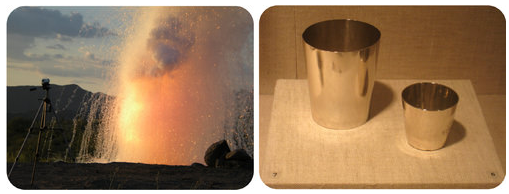
We see below two metals that tin exist exposed to water. The picture on the left is of sodium, which has a violent reaction when it comes in contact with water. The picture on the right is of silver, a metal and so unreactive with h2o that it can exist made into drinking vessels. Both metals have a single \(s\) electron in their outer shell, so you would predict a similar reactivity from each. However, we accept a tool that allows us to make improve predictions about how sure elements will react with others.
The Activity Series
Single-replacement reactions only occur when the element that is doing the replacing is more reactive than the chemical element that is being replaced. Therefore, it is useful to have a list of elements in gild of their relative reactivity. The activeness series is a list of elements in decreasing order of their reactivity. Since metals supercede other metals, while nonmetals replace other nonmetals, they each have a split up activity serial. The table \(\PageIndex{1}\) below is an activity series of well-nigh common metals, and the table \(\PageIndex{2}\) is an action series of the halogens.
| Elements, from nigh to least reactive | Reaction Occurring |
|---|---|
| \(\ce{Li}\) \(\ce{M}\) \(\ce{Ba}\) \(\ce{Sr}\) \(\ce{Ca}\) \(\ce{Na}\) | React with cold water, replacing hydrogen. |
| \(\ce{Mg}\) \(\ce{Al}\) \(\ce{Zn}\) \(\ce{Cr}\) \(\ce{Fe}\) \(\ce{Cd}\) | React with steam, but not cold water, replacing hydrogen. |
| \(\ce{Co}\) \(\ce{Ni}\) \(\ce{Sn}\) \(\ce{Pb}\) | Do not react with water. React with acids, replacing hydrogen. |
| \(\ce{H_2}\) | |
| \(\ce{Cu}\) \(\ce{Hg}\) \(\ce{Ag}\) \(\ce{Pt}\) \(\ce{Au}\) | Unreactive with water or acids. |
| Elements, from most to least reactive |
|---|
| \(\ce{F_2}\) |
| \(\ce{Cl_2}\) |
| \(\ce{Br_2}\) |
| \(\ce{I_2}\) |
For a unmarried-replacement reaction, a given element is capable of replacing an chemical element that is below information technology in the activeness series. This can be used to predict if a reaction volition occur. Suppose that minor pieces of the metallic nickel were placed into two separate aqueous solutions: one of iron (3) nitrate and one of lead (II) nitrate. Looking at the activity serial, we see that nickel is beneath fe, but above lead. Therefore, the nickel metal will be capable of replacing the lead in a reaction, but volition non exist capable of replacing iron.
\[\ce{Ni} \left( south \right) + \ce{Pb(NO_3)_2} \left( aq \right) \rightarrow \ce{Ni(NO_3)_2} \left( aq \right) + \ce{Atomic number 82} \left( south \right)\]
\[\ce{Ni} \left( s \right) + \ce{Iron(NO_3)_3} \left( aq \right) \rightarrow \text{NR (no reaction)}\]
In the descriptions that back-trail the activeness series of metals, a given metallic is also capable of undergoing the reactions described below that section. For example, lithium will react with common cold water, replacing hydrogen. It volition also react with steam and with acids, since that requires a lower caste of reactivity.
Examples \(\PageIndex{1}\)
Use the activity serial to predict if the following reactions will occur. If non, write \(\text{NR}\). If the reaction does occur, write the products of the reaction and balance the equation.
- \(\ce{Al} \left( s \right) + \ce{Zn(NO_3)_2} \left( aq \right) \rightarrow\)
- \(\ce{Ag} \left( s \right) + \ce{HCl} \left( aq \right) \rightarrow\)
Solution
| Steps | Example \(\PageIndex{1A}\) \(\ce{Al} \left( due south \right) + \ce{Zn(NO_3)_2} \left( aq \right) \rightarrow\) | Example \(\PageIndex{1B}\) \(\ce{Ag} \left( s \right) + \ce{HCl} \left( aq \right) \rightarrow\) |
|---|---|---|
| Program the problem. | Compare the placements of aluminum and zinc on the activity series (Table \(\PageIndex{1}\)) | Compare the placements of silvery and hydrogen (Table \(\PageIndex{1}\)) |
| Solve. | Since aluminum is above zinc, it is capable of replacing it and a reaction will occur. The products of the reaction will exist aqueous aluminum nitrate and solid zinc. Take care to write the right formulas for the products before balancing the equation. Aluminum adopts a \(+3\) charge in an ionic compound, so the formula for aluminum nitrate is \(\ce{Al(NO_3)_3}\). The balanced equation is: \(ii \ce{Al} \left( due south \right) + 3 \ce{Zn(NO_3)_2} \left( aq \right) \rightarrow 2 \ce{Al(NO_3)_3} \left( aq \right) + three \ce{Zn} \left( s \right)\) | Since silvery is beneath hydrogen, it is not capable of replacing hydrogen in a reaction with an acid. \(\ce{Ag} \left( s \correct) + \ce{HCl} \left( aq \correct) \rightarrow \text{NR}\) |
Exercise \(\PageIndex{1}\)
Use the activeness series to predict the products, if any, of each equation.
- \(\ce{FeCl2 + Zn →}\)
- \(\ce{HNO3 + Au →}\)
- Answer a
- The products are ZnCl2 + Fe.
- Answer b
- No reaction.
Summary
- Metals and halogens are ranked co-ordinate to their ability to displace other metals or halogens below them in the activity series.
Contributions & Attributions
This page was synthetic from content via the post-obit correspondent(s) and edited (topically or extensively) by the LibreTexts development team to run across platform style, presentation, and quality:
-
Marisa Alviar-Agnew (Sacramento City College)
-
Henry Agnew (UC Davis)
Source: https://chem.libretexts.org/Courses/College_of_Marin/CHEM_114:_Introductory_Chemistry/07:_Chemical_Reactions/7.11:_The_Activity_Series
0 Response to "How to Read the Activity Series Table"
Post a Comment