Boomers Gen-xers and Millennials Understanding the â€å“new Students Educause Review 38(4) 37-47

Millennial life: How young adulthood today compares with prior generations
Over the past l years – from the Silent Generation's young adulthood to that of Millennials today – the United States has undergone large cultural and societal shifts. At present that the youngest Millennials are adults, how do they compare with those who were their historic period in the generations that came before them?
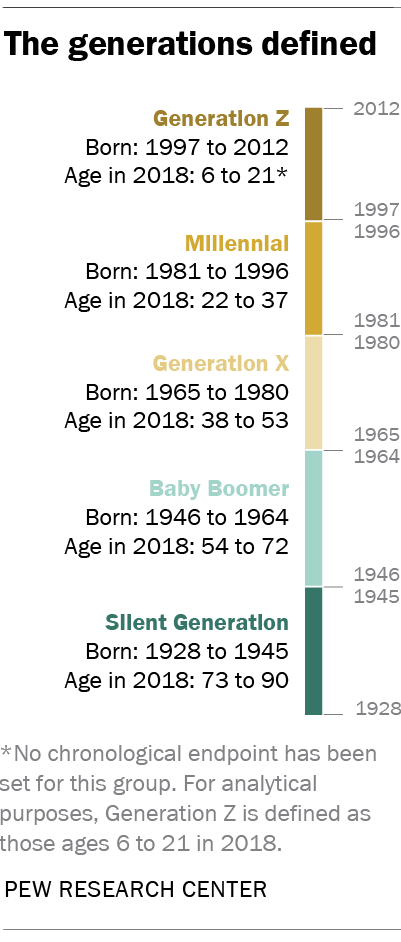 In general, they're better educated – a factor tied to employment and financial well-being – but there is a precipitous separate between the economic fortunes of those who have a college education and those who don't.
Millennials have brought more racial and ethnic diversity to American social club. And Millennial women, like Generation X women, are more likely to participate in the nation's workforce than prior generations.
Compared with previous generations, Millennials – those ages 22 to 37 in 2018 – are delaying or foregoing wedlock and accept been somewhat slower in forming their own households. They are besides more than likely to exist living at abode with their parents, and for longer stretches.
And Millennials are now the 2d-largest generation in the U.S. electorate (after Babe Boomers), a fact that continues to shape the country'southward politics given their Democratic leanings when compared with older generations.
Those are some of the broad strokes that take emerged from Pew Research Centre's work on Millennials over the by few years. Now that the youngest Millennials are in their 20s, we have done a comprehensive update of our prior demographic work on generations. Here are the details.
Education
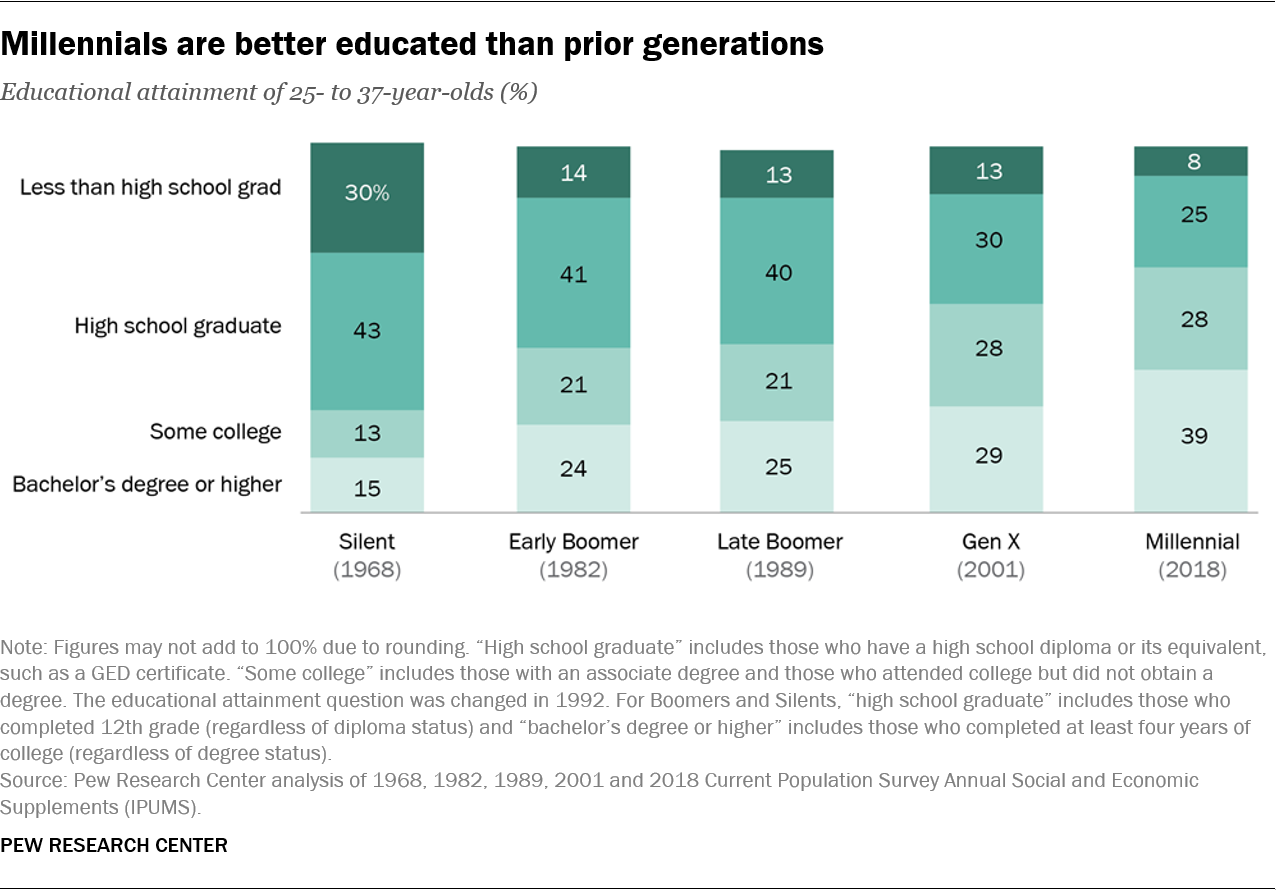
Today's young adults are much better educated than their grandparents, as the share of young adults with a bachelor'southward caste or higher has steadily climbed since 1968. Amid Millennials, around four-in-x (39%) of those ages 25 to 37 have a bachelor'south degree or higher, compared with only 15% of the Silent Generation, roughly a quarter of Babe Boomers and near 3-in-10 Gen Xers (29%) when they were the same age.
Gains in educational attainment have been especially steep for young women. Amidst women of the Silent Generation, only xi% had obtained at least a bachelor's degree when they were young (ages 25 to 37 in 1968). Millennial women are about four times (43%) as probable equally their Silent predecessors to have completed as much education at the aforementioned age. Millennial men are also ameliorate educated than their predecessors. About one-third of Millennial men (36%) have at least a bachelor's degree, nearly double the share of Silent Generation men (19%) when they were ages 25 to 37.
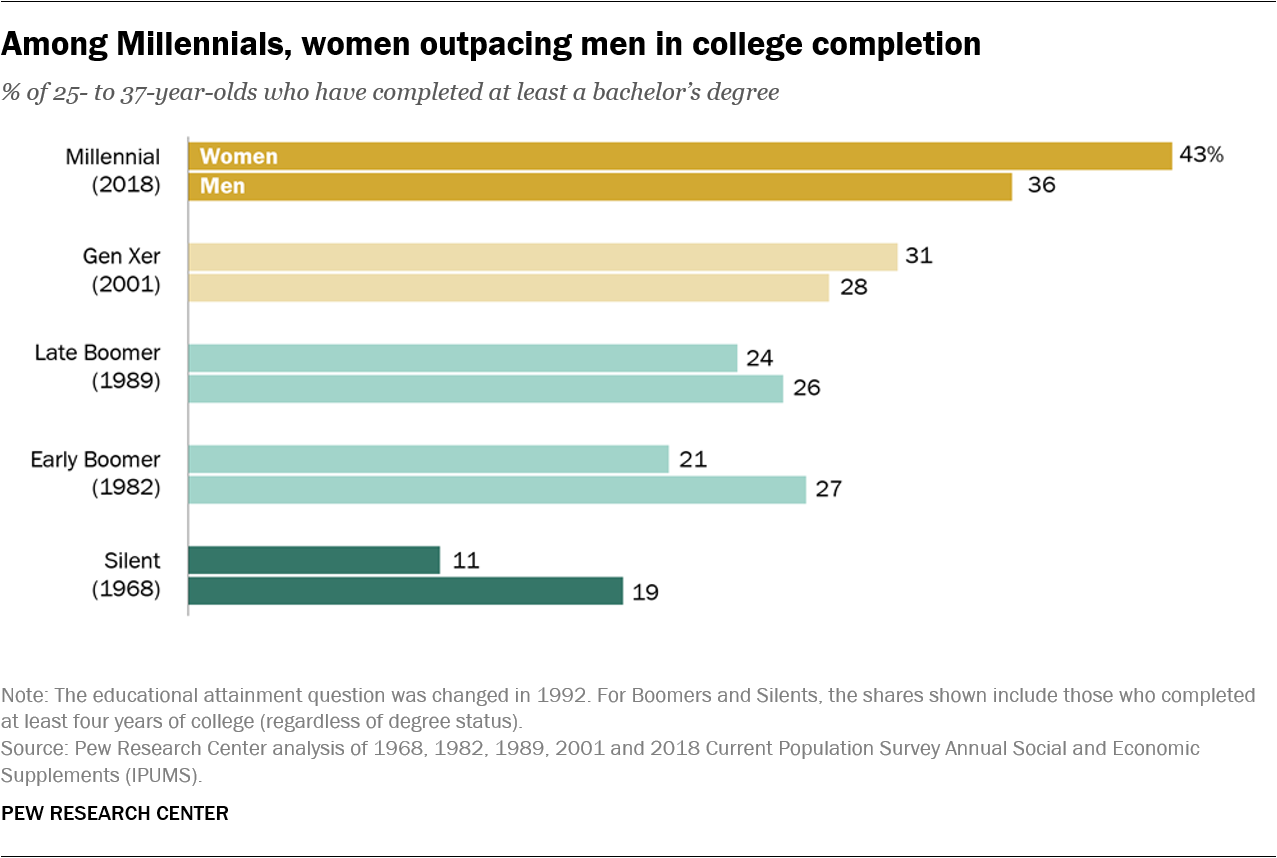
While educational attainment has steadily increased for men and women over the past five decades, the share of Millennial women with a available'south degree is now higher than that of men – a reversal from the Silent Generation and Boomers. Gen 10 women were the first to outpace men in terms of education, with a 3-percent-point reward over Gen Ten men in 2001. Earlier that, belatedly Boomer men in 1989 had a 2-bespeak advantage over Boomer women.

Employment
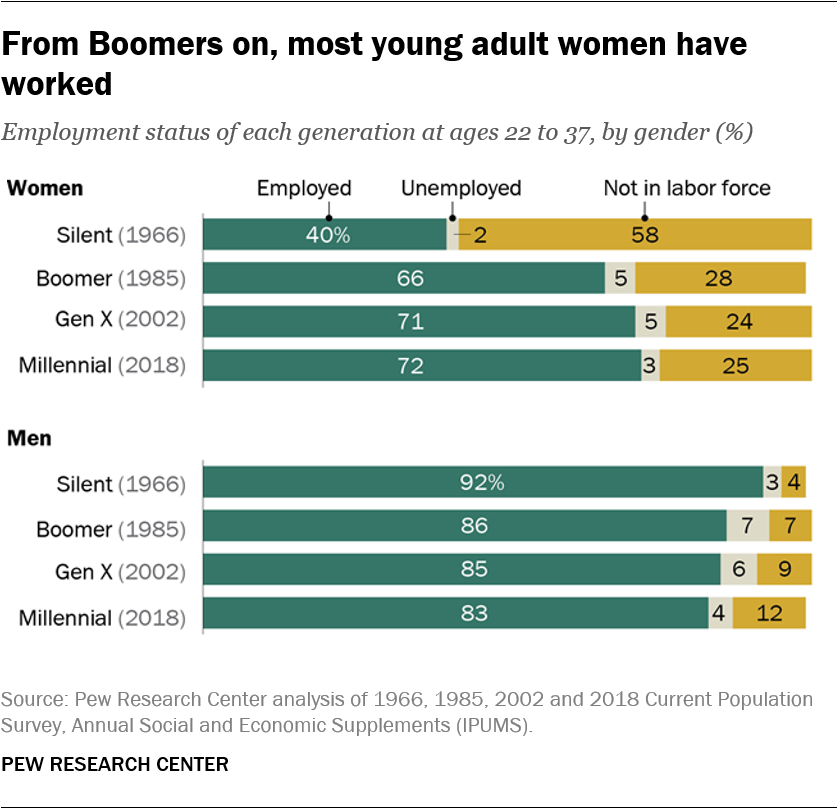 Boomer women surged into the workforce as immature adults, setting the stage for more than Gen X and Millennial women to follow accommodate. In 1966, when Silent Generation women were ages 22 through 37, a majority (58%) were not participating in the labor force while 40% were employed. For Millennial women today, 72% are employed while just a quarter are not in the labor force. Boomer women were the turning point. Equally early as 1985, more than young Boomer women were employed (66%) than were not in the labor force (28%).
And despite a reputation for job hopping, Millennial workers are just as probable to stick with their employers every bit Gen Ten workers were when they were the same age. Roughly seven-in-10 each of Millennials ages 22 to 37 in 2018 (70%) and Gen Xers the same age in 2002 (69%) reported working for their current employer at least 13 months. About iii-in-ten of both groups said they'd been with their employer for at least v years.
Of course, the economy varied for each generation. While the Dandy Recession affected Americans broadly, it created a particularly challenging job marketplace for Millennials entering the workforce. The unemployment rate was especially high for America's youngest adults in the years just after the recession, a reality that would touch Millennials' future earnings and wealth.
Income and wealth
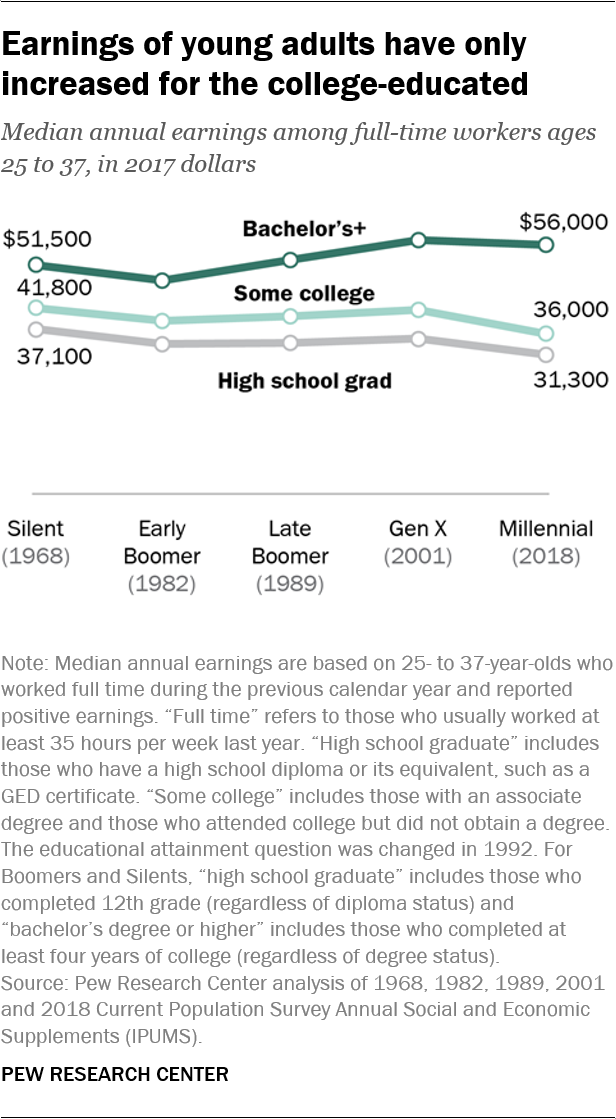
The fiscal well-beingness of Millennials is complicated. The individual earnings for young workers have remained mostly flat over the past fifty years. But this belies a notably big gap in earnings between Millennials who take a higher education and those who don't. Similarly, the household income trends for young adults markedly diverge by education. As far as household wealth, Millennials appear to have accumulated slightly less than older generations had at the aforementioned age.
Millennials with a bachelor's degree or more and a full-time job had median annual earnings valued at $56,000 in 2018, roughly equal to those of college-educated Generation X workers in 2001. Just for Millennials with some higher or less, annual earnings were lower than their counterparts in prior generations. For example, Millennial workers with some college pedagogy reported making $36,000, lower than the $38,900 early on Baby Boomer workers made at the same age in 1982. The pattern is similar for those immature adults who never attended college.
Millennials in 2018 had a median household income of roughly $71,400, similar to that of Gen X young adults ($70,700) in 2001. (This analysis is in 2017 dollars and is adjusted for household size. Additionally, household income includes the earnings of the young developed, as well as the income of anyone else living in the household.)
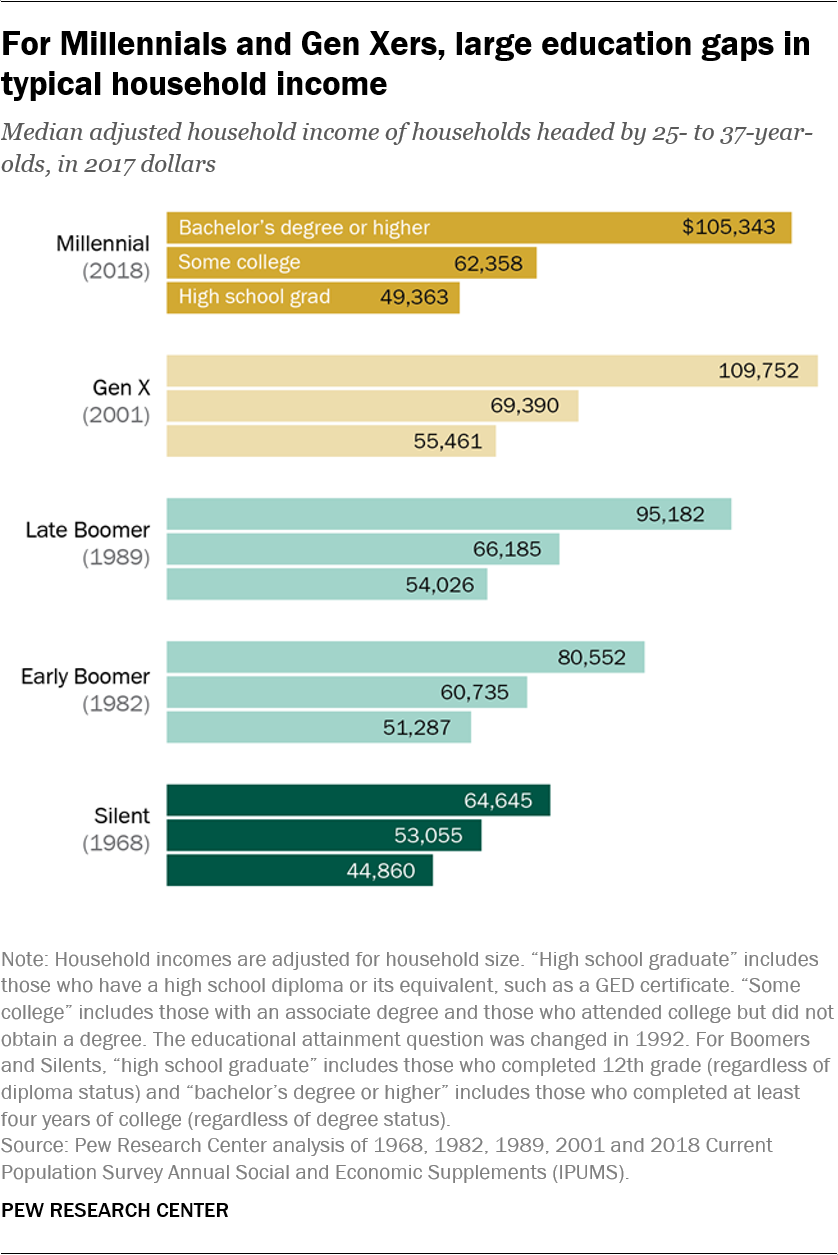 The growing gap by education is even more apparent when looking at annual household income. For households headed by Millennials ages 25 to 37 in 2018, the median adjusted household income was about $105,300 for those with a bachelor'due south degree or college, roughly $56,000 greater than that of households headed by high school graduates. The median household income difference by teaching for prior generations ranged from $41,200 for late Boomers to $nineteen,700 for the Silent Generation when they were young.
While young adults in general do not have much accumulated wealth, Millennials take slightly less wealth than Boomers did at the aforementioned age. The median net worth of households headed by Millennials (ages 20 to 35 in 2016) was about $12,500 in 2016, compared with $20,700 for households headed past Boomers the same age in 1983. Median net worth of Gen X households at the aforementioned age was about $xv,100.
This modest difference in wealth can exist partly attributed to differences in debt past generation. Compared with before generations, more Millennials have outstanding student debt, and the amount of it they owe tends to be greater. The share of young adult households with any student debt doubled from 1998 (when Gen Xers were ages 20 to 35) to 2016 (when Millennials were that historic period). In improver, the median amount of debt was well-nigh 50% greater for Millennials with outstanding educatee debt ($19,000) than for Gen 10 debt holders when they were young ($12,800).
Housing
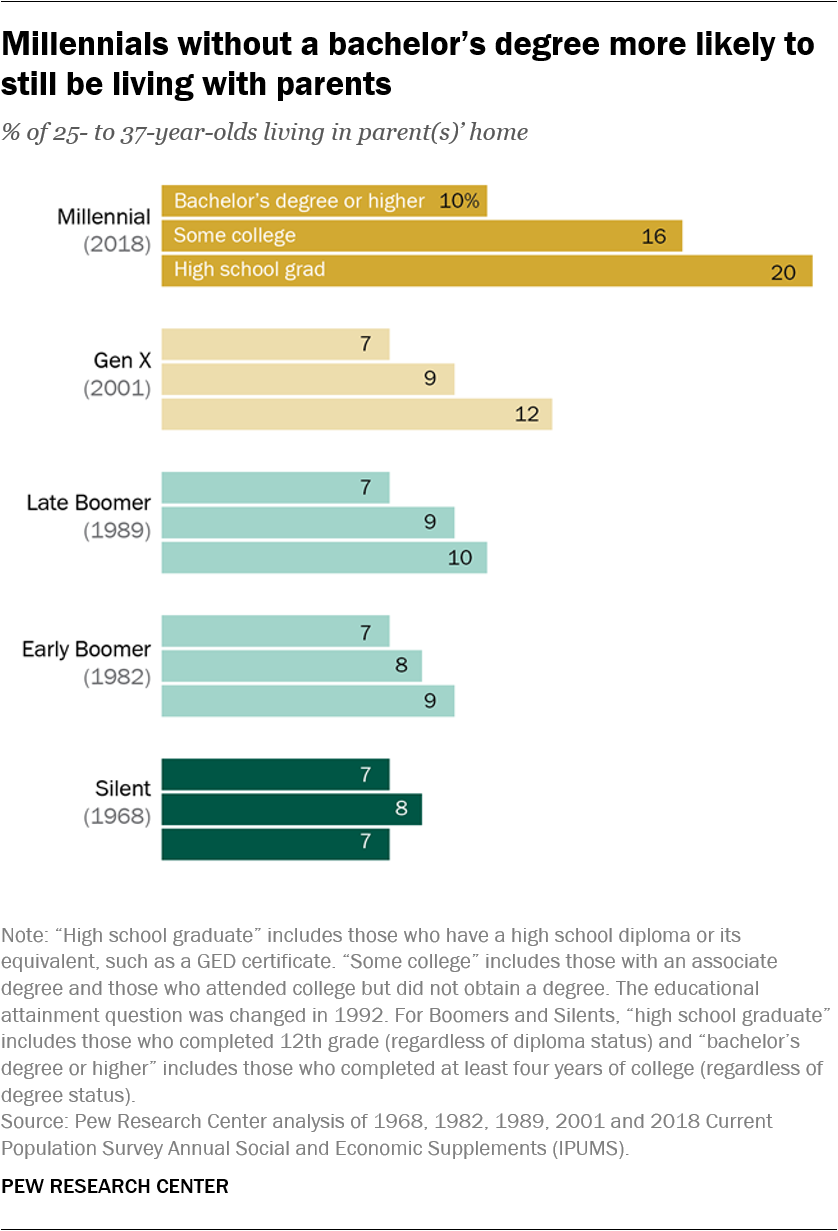 Millennials, hitting difficult by the Groovy Recession, accept been somewhat slower in forming their ain households than previous generations. They're more likely to live in their parents' domicile and also more likely to be at home for longer stretches. In 2018, 15% of Millennials (ages 25 to 37) were living in their parents' home. This is nearly double the share of early on Boomers and Silents (8% each) and 6 percentage points higher than Gen Xers who did so when they were the aforementioned age.
The ascension in immature adults living at home is specially prominent among those with lower education. Millennials who never attended college were twice as likely as those with a bachelor's degree or more to live with their parents (20% vs. 10%). This gap was narrower or nonexistent in previous generations. Roughly equal shares of Silents (about 7% each) lived in their parents' dwelling when they were ages 25 to 37, regardless of educational attainment.
Millennials are also moving significantly less than earlier generations of young adults. About i-in-half-dozen Millennials ages 25 to 37 (16%) have moved in the past year. For previous generations at the same age, roughly a quarter had.

Family
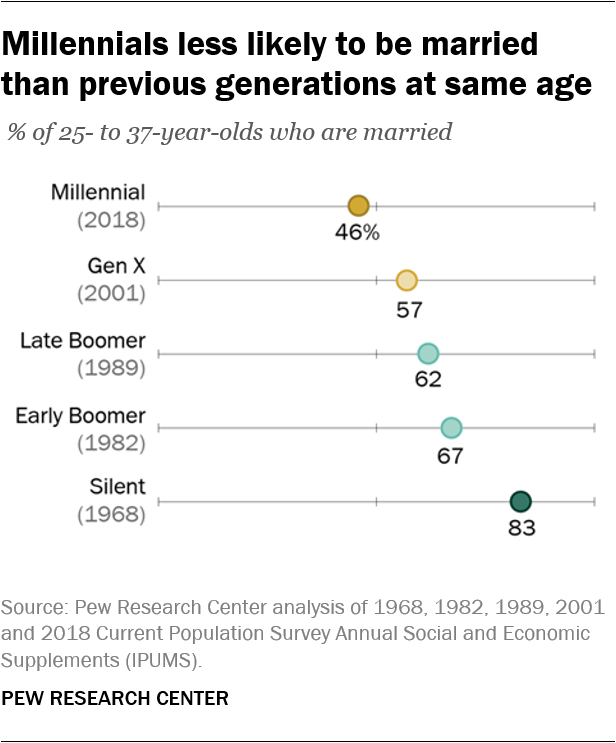 On the whole, Millennials are starting families later than their counterparts in prior generations. Just under half (46%) of Millennials ages 25 to 37 are married, a steep drop from the 83% of Silents who were married in 1968. The share of 25- to 37-yr-olds who were married steadily dropped for each succeeding generation, from 67% of early Boomers to 57% of Gen Xers. This in office reflects broader societal shifts toward marrying later in life. In 1968, the typical American woman first married at age 21 and the typical American man first wed at 23. Today, those figures accept climbed to 28 for women and 30 for men.
Merely information technology's not all nearly delayed marriage. The share of adults who take never married is increasing with each successive generation. If electric current patterns keep, an estimated 1-in-iv of today's young adults will take never married by the fourth dimension they reach their mid-40s to early 50s – a record high share.
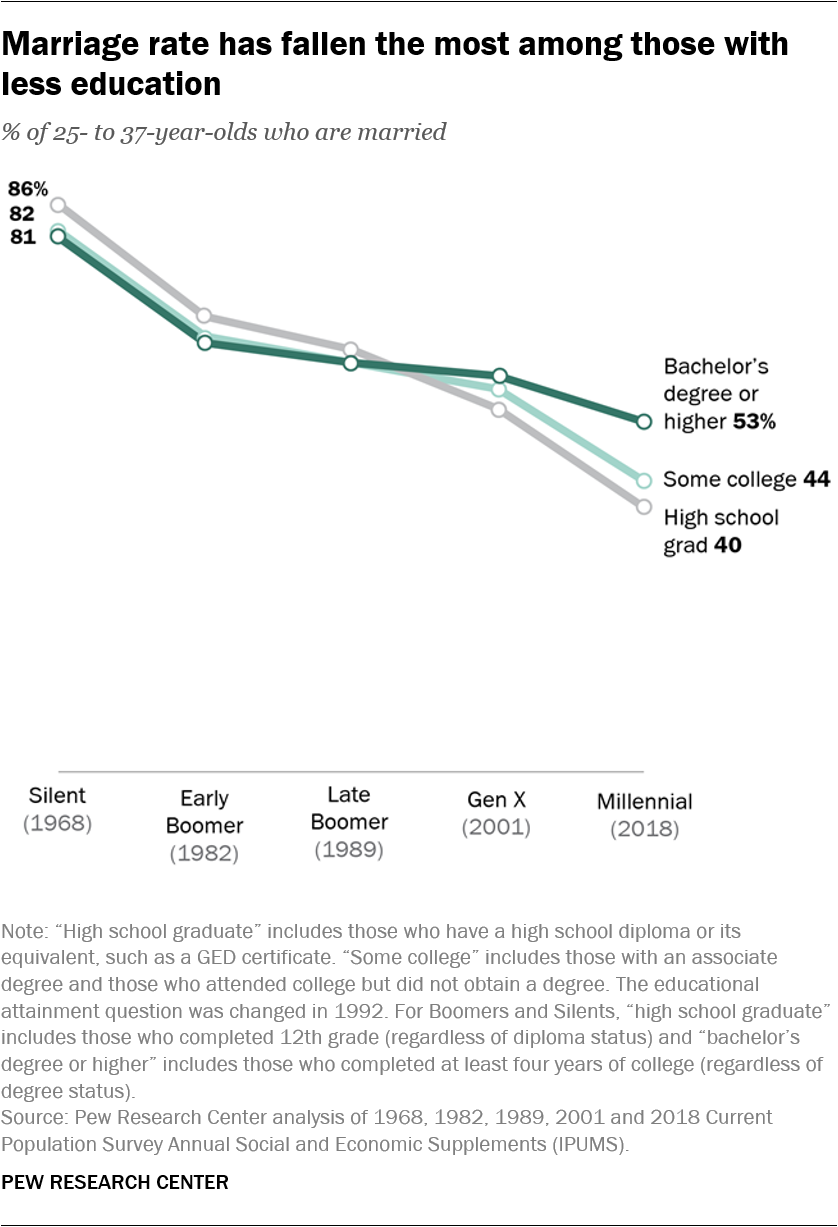 In prior generations, those ages 25 to 37 whose highest level of didactics was a high school diploma were more than likely than those with a bachelor's caste or college to be married. Gen Xers reversed this trend, and the split widened among Millennials. Iv-in-ten Millennials with just a high school diploma (40%) are currently married, compared with 53% of Millennials with at least a bachelor's degree. In comparison, 86% of Silent Generation loftier school graduates were married in 1968 versus 81% of Silents with a bachelor's degree or more.
Millennial women are also waiting longer to become parents than prior generations did. In 2016, 48% of Millennial women (ages 20 to 35 at the time) were moms. When Generation X women were the same historic period in 2000, 57% were already mothers, similar to the share of Boomer women (58%) in 1984. Even so, Millennial women at present account for the vast majority of annual U.Southward. births, and more than 17 1000000 Millennial women have become mothers.
Voting
Younger generations (Generation X, Millennials and Generation Z) now make upwardly a clear majority of America's voting-eligible population. As of November 2018, nearly six-in-x adults eligible to vote (59%) were from one of these three generations, with Boomers and older generations making up the other 41%.
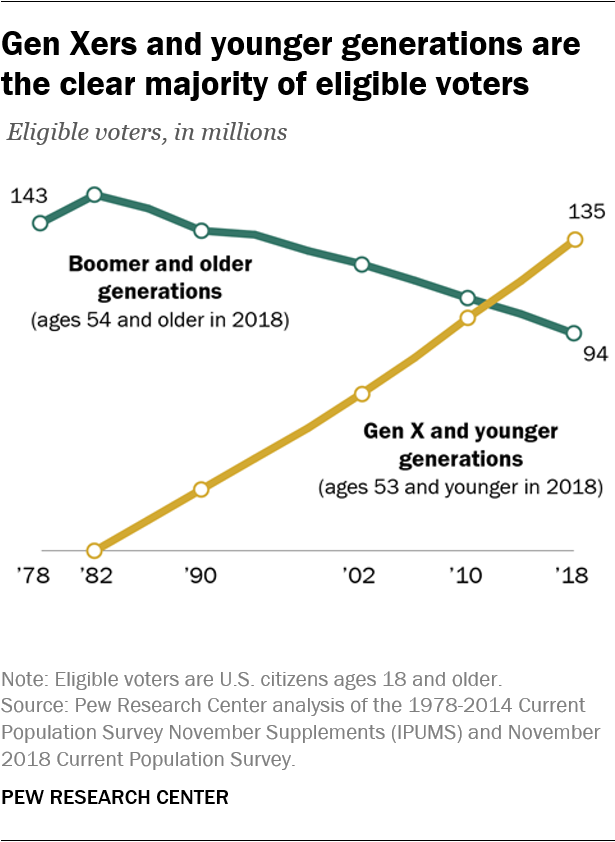 Still, young adults have historically been less likely to vote than their older counterparts, and these younger generations have followed that same pattern, turning out to vote at lower rates than older generations in recent elections.
In the 2016 election, Millennials and Gen Xers cast more than votes than Boomers and older generations, giving the younger generations a slight majority of total votes bandage. However, higher shares of Silent/Greatest generation eligible voters (70%) and Boomers (69%) reported voting in the 2016 election compared with Gen 10 (63%) and Millennial (51%) eligible voters. Going forward, Millennial turnout may increase every bit this generation grows older.
Generational differences in political attitudes and partisan affiliation are as wide as they have been in decades. Among registered voters, 59% of Millennials affiliate with the Democratic Party or lean Democratic, compared with well-nigh half of Boomers and Gen Xers (48% each) and 43% of the Silent Generation. With this divide comes generational differences on specific issue areas, from views of racial bigotry and clearing to foreign policy and the scope of authorities.
Population change and the future
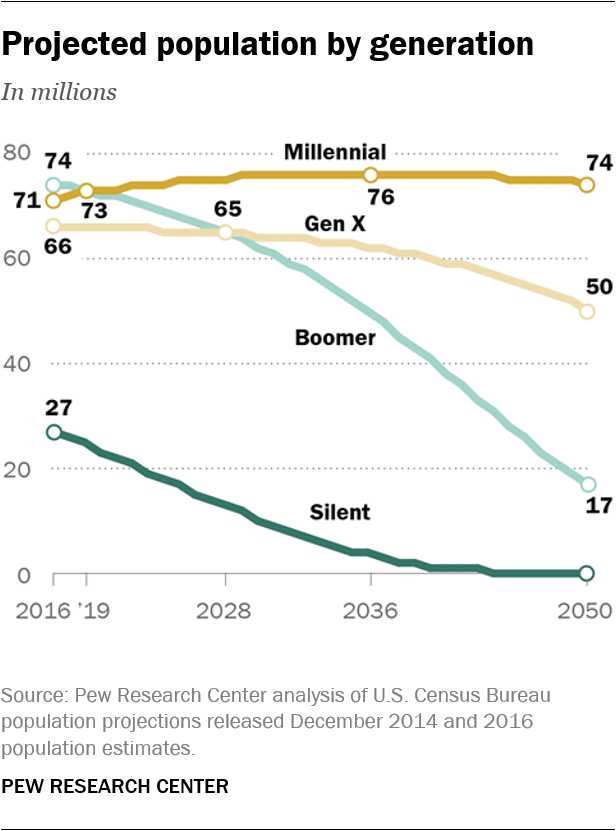
Past 2019, Millennials are projected to number 73 million, overtaking Baby Boomers as the largest living adult generation. Although a greater number of births underlie the Babe Boom generation, Millennials volition outnumber Boomers in part because clearing has been boosting their numbers.
 Millennials are likewise bringing more than racial and indigenous diversity. When the Silent Generation was young (ages 22 to 37), 84% were not-Hispanic white. For Millennials, the share is but 55%. This change is driven partly by the growing number of Hispanic and Asian immigrants, whose ranks have increased since the Boomer generation. The increased prevalence of interracial marriage and differences in fertility patterns accept also contributed to the country'south shifting racial and ethnic makeup.
Looking alee at the next generation, early benchmarks show Generation Z (those ages 6 to 21 in 2018) is on track to be the nation'south most diverse and best-educated generation yet. Most half (48%) are racial or ethnic minorities. And while most are still in K-12 schools, the oldest Gen Zers are enrolling in college at a higher charge per unit than fifty-fifty Millennials were at their age. Early indications are that their opinions on bug are similar to those of Millennials.
Of course, Gen Z is still very young and may be shaped by future unknown events. But Pew Research Center looks forrad to spending the side by side few years studying life for this new generation as it enters adulthood.
All photos via Getty Images
Source: https://www.pewresearch.org/social-trends/2019/02/14/millennial-life-how-young-adulthood-today-compares-with-prior-generations-2/
0 Response to "Boomers Gen-xers and Millennials Understanding the â€å“new Students Educause Review 38(4) 37-47"
Post a Comment